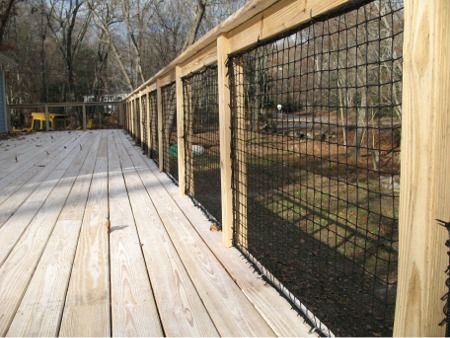
You may have heard of TimberSil treated southern yellow pine. It pops up in reviews and press releases here and there. Rather than using treatment soups that kill wood eating insects or fungi, TimberSill uses a mineral, sodium silicate, to essentially encapsulate the cells of the wood in a glass. Wood munching organisms don’t recognize the treated wood as food and leave it alone. The treatment takes place in a conventional pressure-treatment vessel followed by heating in a kiln.
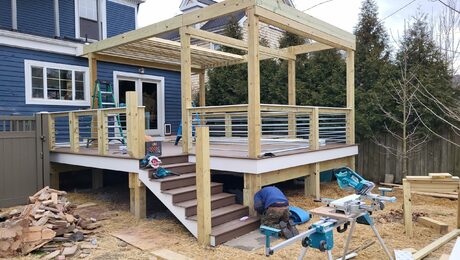
I wanted to try TimberSil out for several years but their distribution was limited (and still is). About a year and a half ago I placed a special order for a factory direct shipment for a large deck project. When the wood arrived, it was ugly and I was worried. Most of the decking was coated with large shiny amber splotches about 1/32 in. thick and the 2x and 4x stock covered with white power. I took a gamble and pressed forward with the project. After several weeks of rain and sun that the deposits washed away leaving the natural blond of the yellow pine.
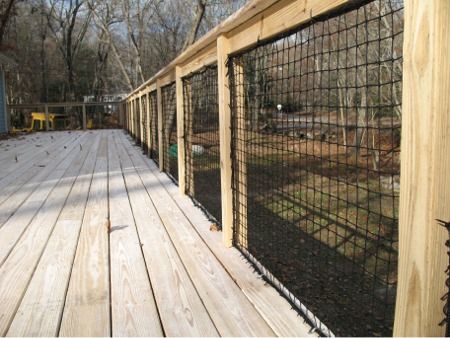
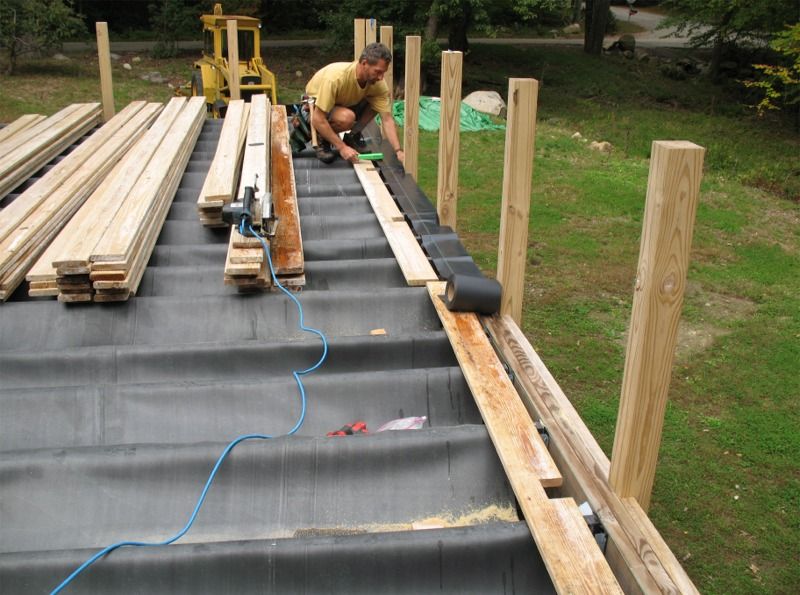
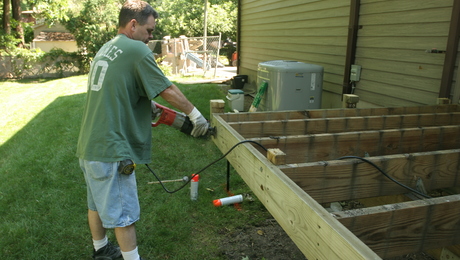
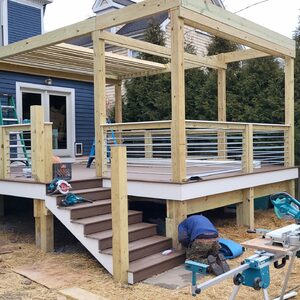
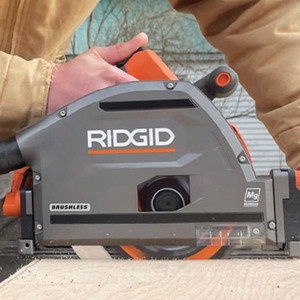
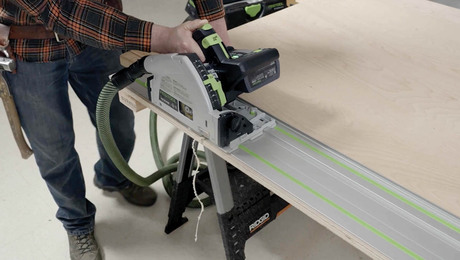
Working with TimberSil Despite rumors that TimberSil dulls carbide teeth, I cut my way through over 1200 board feet of stock with a single 7 1/4 blade. And there was no dulling of the ordinary ½ inch spade bit I used to bore 60 holes through 4×4 guardrail posts either. The material was what you’d expect from a premium quality SYP; few knots, pretty straight grained and no wane.
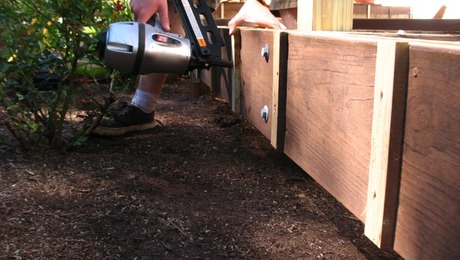
I face screwed 900 square feet of 5/6 x 6 TimberSil with HDG bugle headed screws using an autofeed screw driver and didn’t have any splitting. I did predrill for all the butt end screws as with any decking. The screws did hesitate penetrating the surface of the boards but once the threads bit they drove right in.
What I wasn’t anticipating was the gray mold spots that developed within 2 months. It became unsightly by the third month but amazingly disappeared on its own after 6 months despite one of the wettest springs I can recall. I can only attribute it to seasonal pollen and dust that collected and not the TimberSil itself.
TimberSil has some pretty good properties beyond being benign:
It’s Class A fire rated (good for woodland interface areas)
Hardness and strength are increased by about 50%. You can span 24 in. joists with 5/4 x 6 decking without any spring.
Not corrosive to fasteners.
Dimensionally stable. It doesn’t absorb much moisture so it doesn’t shrink and swell like some wood decking species.
Rated for Ground Contact
Takes stain and paint without bleed-thru.
TimberSil has some downsides though:
Though available from ME to CA distribution is spotty.
Only one producing plant (hopefully that will change)
Cost – It runs higher than run-of-the-mill PT. It’ll likely come down as more treaters adopt the process.
It’s heavy. Even though it’s kiln dried after treatment, it’s as heavy as wet PT lumber or composite decking.















View Comments
Thanks Mike! It's one thing to get the technical specs and a scientific explanation of why stuff like this works, but a first-hand account of what it's like to use it is probably the most valuable bit of info. I'll definitely try TimberSIL if I can get my hands on some!
Mike, looks like you were also using DekDrain on this project. Care to comment on that, DryJoist, and/or any similar systems?
ewoodhouse:
What you see covering the joists is EPDM. Couple years ago I priced out a number of the 10 underdeck drainage systems out there and considered their installation details. I worked out a system to use EPDM that's fast, easy and less than half the cost of commercial systems. FHB's Chuck Bickford already photographed and video taped the process and I wrote up an outline for an article. Still awaiting Brian Pontolilo's go-ahead. I'm guessing the soonest it will appear in the magazine is a year.
A year at the soonest, eh? I need to do something like that much sooner than that, so I guess I'll just have to figure it out. Nice to know that you can beat the price of the commercial systems, though.
ewoodhouse - I'll send you the text draft of the article. No photos but you may be able to sort it out. Email me with your email - [email protected]
Mike,
Thanks for this very useful post. I've been considering using Timbersil for a deck project coming up. Great to hear from someone who has actually used the product. It'll be nice to use a real wood product with good evironmental properties.
I've used the product. Yes it's quite heavy and although they claim it can be painted and stained.... well I wouldn't recommend it. I have a habit of acquiring samples and doing my own tests. There are very slick shiny spots when stained that are rather blinding in the sun. I also found it to swell with moisture, so be careful not to apply boards as with PT. When your order is placed, don't take delivery of any component until the order is complete. I found once you've taken delivery on the majority of your order.... need I say more. Customer service doesn't seem to be a point they're interested in quite yet. Lastly, I had some of the posts simply pop apart due to the high temps used to melt the silica. Order extra. Many of the boards arrived with split ends. I won't be using it again until I can pull it off the shelf of a stcking dealer. But it doesn't burn!
We are a West Coast Source of TimberSIL-Environmental Safe Wood Company- http://www.eswoodco.com. In response to alldeckedout we are a dealer and pride ourselves that our customers are number one. From consulting and providing solutions for your project to personal delivery. Depending one project as with any lumber species grade is everything. Structural you can use a lower grade, cosmetic us a higher grade or clear. End splits are a commom lumber charictistic on KD. An example of our solutons we assist our clients was a client wanted 1x12 8'. After determining the material use we recommended the following: because 1x2 from any mill in the softwoods he would not be happy because of the type of cut if not handled properly that we should take #1 prime 1x6 and T&G and glue. End result was that it came out wonderful and client ( World known amusement park) was very happy with result.
Contact us a [email protected] or http://www.eswoodco.com...we are what you want is service from a company. Serving all the west coast.
For a list of TimberSIL wood Authorized Dealers & Distributors please visit: http://www.timbersilwood.com/authorized-dealers.html
For the latest TimberSIL news and recently submitted photos visit: http://timbersil.wordpress.com/
Environmental Safe Wood Company is NOT a TimberSIL Wood Authorized Dealer.
I would like to use this wood in South Carolina for a deck. Framing and decking. But am concerned after reading the comments by alldeckedout. I want to paint the deck posts and am not sure is solid 6x6 posts wold be dimensionally stable. Does anyone have experience on laminating the wood to make hollow posts for railing? After sanding does it take primer and paint well?
I have a customer who had a Timbersil deck built a littel over a year ago. Over the winter it developed hair!
What I mean is basically everywhere on the deck and rails is what looks like a mat of what I can olny assume is glass fibers. They resemble asbestos insulation fibers and are loosely attached to the deck.
Has anyone experienced this? Any methods to deal with it and remove it? Reasons why it happened? Why it happened? How to prevent it?
DavePro,
I would be interested to see photos of the "hair" like growth you described. I have not seen, nor have I heard of such a thing happening. What color is the growth?
Can you please send digital photos to [email protected]
I built a large deck with Timbersil two years ago. It has been a disaster. First of all, the boards would not take a stain. A Timbersil representative came to the property and told me to sand the boards (he said he would pay for the sanding, but then has failed to honor his committment). When sanded, the boards would only take one kind of stain (stain for log houses, very expensive). Unfortunately that stain did not last. After one year, it has faded. Now the boards are developing moldy spots, have become very uneven (twisting and warping) and the entire deck has to be replaced. Timbersil refuses to answer my calls (a secretary has called me back but always with the message that the person(s) whp might be able to help are unavailable). Timbersil representatives are not standing by any guarantees or warranties. Buyers beware!
I built a deck in early Spring 2011. Planks started to blacken by May so I contacted the company. They offered to pay for new boards and a very expensive sealant called Seal-Once (they never made good on it). I have been in constant contact with them via email over the past two years. Now, the deck is completely covered in fuzz. I had it analyzed by a home inspector and it's full of mold and bacteria.
Terrible product if you live where there's rain or snow. The company basically told me to take a hike and sent me a gallon of JoMax and a letter stating that "everything needs maintenance".
No one seems to be able to help so I am going to have to pull up the deck and start again. STAY AWAY!!!!
We had a 12x20 foot deck built out of timbersil three years ago. It turned out very nice. The contractor finished it with a Penofin stain (I think it was the blue label, but I don't remember for sure). This deck is totally exposed and located in the mountains of Southern California at about 5600 feet, so it gets about 40" of snow and 25" of rain each year.
The boards do swell during the winter when they are wet for long periods of time. When dry they are about 1/8 apart, but when they get wet they touch. Some of the grain is starting to lift on the flat deck boards. There are a few cracks in some of the 4x4 posts. Overall it is still very sturdy and looks pretty good. We need to restain it this summer before next winter. We want to do it ourselves rather than hiring a contractor.
I have a question, how do we go about staining it? I assume we sand any high spots of grain, wash it all down and let it dry for a few days before staining. We are going to use the same brand of stain so it will be compatible with areas that still have stain. We don't have to remove all of the stain first do we? Do we just wash it with a hose or powerwash it? How long should we let it dry before we restain it? It will get dusty during the drying time, do we just sweep it and then stain once it is dry? Are we doing it right? Any insight will be most appreciated. Thank you.
In high humidity environments the TimberSil lumber seems to ROT.
http://www.theneworleansadvocate.com/home/7899967-172/wood-product-said-rotting-in
The class action law firm Halunen & Associates is investigating TimberSIL decking for a possible defective product lawsuit. The material is showing signs of rotting, despite being guaranteed for 40 years. If you have experienced any of these problems, you can share your concerns with the firm at http://consumer.halunenlaw.com/contact-us/
or call (612) 605-4098.
Advertising Material.
We live in So. Cal in a canyon and rebuilt our patio cover with TimberSil last year, due to the constant threat of wildfires.
Two weeks ago, we finally had rain and a hail storm. Despite each slat being sanded and primed, per Timbersil, the paint bubbled, and is now chipping and peeling in strips, with sap seeping from one of the main joists.
Prior to the installation, I had researched TimberSil for two years with a few visits to their office in Placentia, CA. Today I found out the Placentia location has closed and as I sat in front of their former office site, I googled to try to find their new location and discovered several websites stating TimberSil's failures.
My contractor said it was a horrible product, and did not want to use it. He said he had to go through several pieces of twisted wood and would choose one good piece for every six. He begged that I change my mind, but unfortunately, I was sold on their product.
AS we peel the paint off, there is a powdery substance which we are still researching as the 'salty residue' others see emerge after being exposed to excess moisture. What a disappointment.
I have found this site http://coastwideshadesails.com.au/shade-sails-products/shade-sails/, and I am sure it's something that would fit and add some unique look for that walkway, have you consider that one?
Nice post.Thanks
Great post you share us.