Buyer’s Guide to Insulation: Batts
These narrow, fluffy blankets of insulation are installed between studs, joists, or rafters. While most batts are made of fiberglass, batts also can be made of cotton, mineral wool, and even hemp.
Fiberglass batts
 Charles Bickford
R-VALUE: R-3.2 to R-3.8 per in.
COST:Between 49¢ to $1 per sq. ft. (installed), depending on thickness
APPLICATION:Above-grade walls, ceilings, and vented roof assemblies
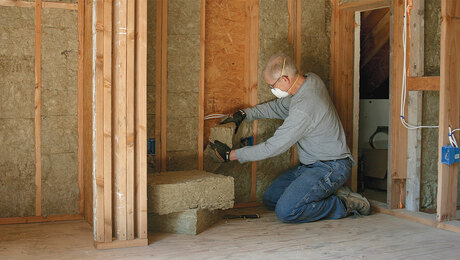
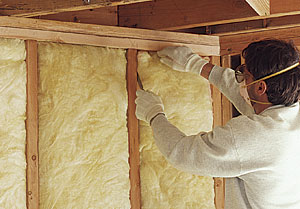
Because fiberglass batts are inexpensive and can be installed without special equipment, they are by far the most common type of residential insulation. Most fiberglass batts are made from spun glass fibers held together by a phenolformaldehyde glue; however, at least two manufacturers—Johns Manville and Knauf—sell formaldehyde-free batts.
Fiberglass batts are available unfaced (photo above) or faced with a variety of materials, including kraft paper, foil-faced paper, MemBrain (a “smart” vapor retarder with variable vapor permeance), and vinyl (either perforated or unperforated). These days, most building scientists discourage the use of interior vapor barriers—that is, materials with a very low permeance—except in very cold climates. A vapor retarder is safer than a vapor barrier; kraft facing (with a permeance of 0.3 perm) is usually safer than interior polyethylene (with a permeance of 0.06 perm). The kraft facing on fiberglass batts satisfies the code requirement for an interior vapor retarder in cold climates.
Fiberglass batts have R-values ranging from R-3.2 to R-3.8 per in. Denser batts have higher R-values; the only virtue of the low-density batts is their comparatively low cost. The installed cost of R-13 to R-15 fiberglass batts for a 2×4 wall is about 49¢ to 80¢ per sq. ft., R-19 to R-21 batts for a 2×6 wall cost about 55¢ to 90¢ per sq. ft., and R-38 batts for an attic cost 71¢ to $1 per sq. ft.
Fiberglass batts do little to slow air leakage, so they must be installed in conjunction with a well-detailed air barrier to perform their best. Unaddressed air leaks through fiberglass-insulated walls can easily lead to condensation and moisture problems.
Installing batts well is difficult, in part because each batt must be carefully cut (and sometimes split) to conform to the idiosyncrasies of each framing bay. Small installation mistakes will lead to large performance penalties.
Cotton batts
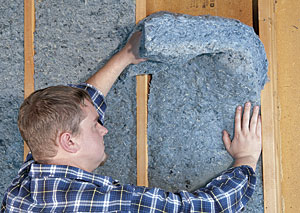 Courtesy of Bonded Logic
R-VALUE: R-3.5 to R-3.7 per in.
COST: About $1.27 to $1.40 per sq. ft. (installed), depending on thickness
APPLICATION: Above-grade walls, ceilings, and vented roof assemblies
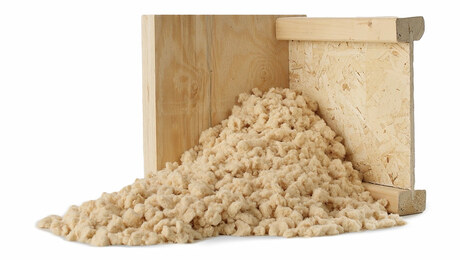
Cotton insulation is sold in the form of unfaced batts, the bestknown brand being UltraTouch from Bonded Logic. About 75% of the material used to make cotton insulation comes from fabric scraps left over from the manufacture of blue jeans, with some synthetic fibers added to maintain loft. Nontoxic flame retardants similar to those used in clothing are also added.
Although less likely to irritate skin than fiberglass batts, cotton batts have some drawbacks. Like fiberglass batts, cotton batts are air permeable and difficult to install well. Cotton batts are also manufactured in a larger width (16-1/4 in. instead of 15-1/2 in.), a drawback that is complicated further by the fact that they are difficult to cut. Some installers complain that cotton batts compressed for shipping do not spring back to the thickness listed on the label. Finally, cotton batts are more expensive than their fiberglass counterparts. For example, the installed cost of R-19 to R-21 cotton batts in 2×6 walls is about $1.37 per sq. ft.
Mineral-wool batts
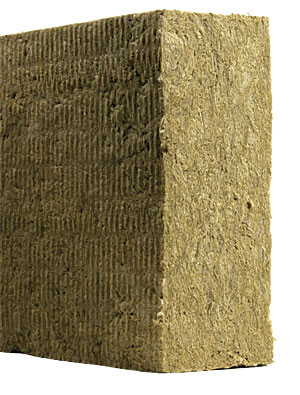 Rodney Diaz
R-VALUE: R-3.8 to R-4.3 per in.
COST: About $1.08 per sq. ft. for R-23 batts for a 2×6 wall
APPLICATION: Above-grade walls, ceilings, and vented roof assemblies
Most mineral-wool batts sold in North America are slag wool, an insulation made from steel-mill slag. The two main manufacturers of mineral-wool insulation are Roxul and Thermafiber.
Mineral-wool batts have R-values ranging from R-3.8 to R-4.3 per in. The insulation is available in densities from 4 to 8 lb. per cu. ft. Because mineral-wool insulation is resistant to high temperatures, it’s the best insulation to use near a chimney or metal flue. The installed cost of R-23 batts from Roxul, meant for a 2×6 wall, is about $1.08 per sq. ft.