previous
  • Fine Homebuilding: The Digital Issues
    Fine Homebuilding: The Digital Issues
  • 12 Remodeling Secrets Revealed
    12 Remodeling Secrets Revealed
  • The Inspector Game: Decking Dos and Don'ts
    The Inspector Game: Decking Dos and Don'ts
  • How it Works
    How it Works
  • 9 Design Ideas & Tips for Concrete Countertops
    9 Design Ideas & Tips for Concrete Countertops
  • 2012 HOUSES Awards
    2012 HOUSES Awards
  • 10 Basement-Remodeling Tips and Techniques
    10 Basement-Remodeling Tips and Techniques
  • Buyer's Guide to Decking
    Buyer's Guide to Decking
  • 7 Solutions for Kitchen Layout and Design
    7 Solutions for Kitchen Layout and Design
  • Painting Ideas, Tips, and Techniques for a Professional Finish
    Painting Ideas, Tips, and Techniques for a Professional Finish
  • 13 Door Design and Installation Tips
    13 Door Design and Installation Tips
  • Outdoor Kitchen Design Inspiration
    Outdoor Kitchen Design Inspiration
  • Complete Kitchen and Bath Guide
    Complete Kitchen and Bath Guide
  • Guide to Paperless Drywall
    Guide to Paperless Drywall
  • Roofing articles, videos, tools, and materials
    Roofing articles, videos, tools, and materials
  • Deck Design & Construction Showcase
    Deck Design & Construction Showcase
  • Energy-Smart Details
    Energy-Smart Details
  • 15 Coffered Ceiling Design Ideas and Tips
    15 Coffered Ceiling Design Ideas and Tips
  • Meet the Fine Homebuilding Project House!
    Meet the Fine Homebuilding Project House!
  • 7 Small Bathroom Floorplan Layouts
    7 Small Bathroom Floorplan Layouts
next
Pin It

What's the Difference: Amp hours

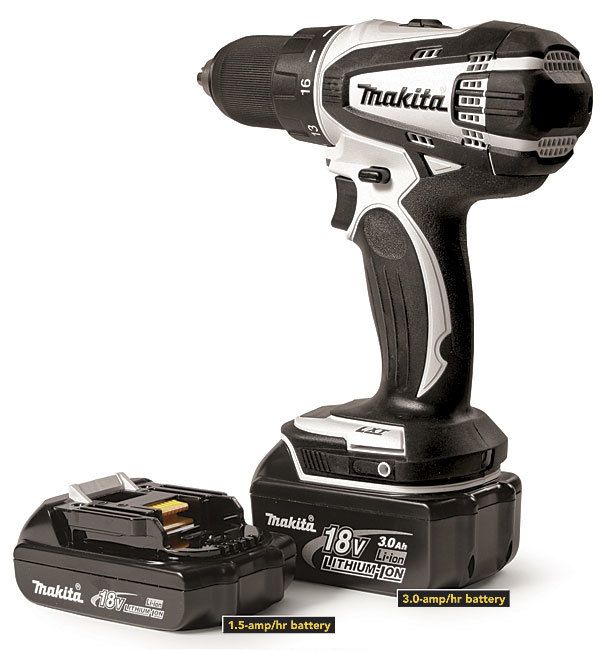
The rise in popularity of lithium-ion batteries in power tools over the past six years has brought consumers voltage options ranging from a compact 3.6v up to a muscle-packed 36v. It’s now also common to find Li-ion battery packs from the same brand, for the same tool, labeled with the same voltage, but in two different sizes. The difference is the amp-hour (amp/hr) rating.

Amp/hr is a measure of a battery’s capacity, not its power. Assuming the voltage is the same, a battery pack with a higher amp/hr rating is like a car with a bigger fuel tank. It can’t drive faster; it just goes farther between fill-ups.

Some companies have names for the different sizes. Bosch, for instance, calls its Slim Pack and Fat Pack. Other makers list the size on one or both batteries. A 3-amp/hr battery will run twice as long as a 1.5-amp/hr battery, assuming—and this is a big assumption—that the workload is identical.
If your common tasks include installing cabinet hinges, drilling pilot holes, or sinking drywall screws, a 1.5-amp/hr pack will be more than adequate. If, however, you routinely drill 2-in.-dia. holes through old-growth framing lumber, sink 8-in.-long lag screws into deck ledgers, or just want to go for a longer time between charges, go with a 3-amp/hr pack.
Photo: Rodney Diaz
From Fine Homebuilding224 , pp. 34 November 10, 2011