
Choosing the Right Hand Float for Your Next Concrete Project
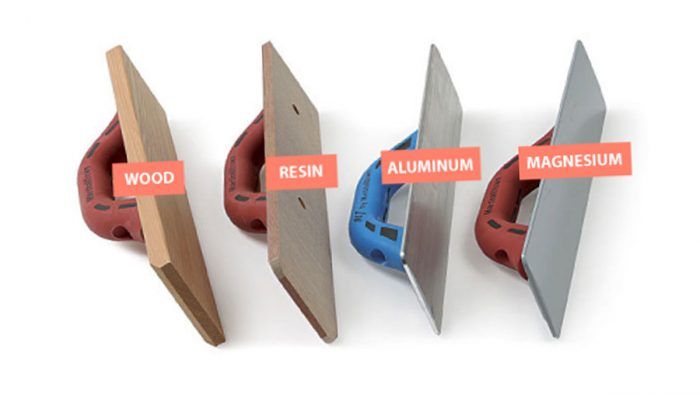
Wood, resin, magnesium, and aluminum versions of this essential masonry tool all have their pros and cons.
Once a slab has been poured, screeded, and bull-floated (see “Creating a Curved Concrete Walkway” in FHB #221), it’s time for hand floats.
A bull float is used to smooth 95% of a slab, but it has a tendency either to pull a small amount of concrete away from the edges of the slab or to push concrete toward the edge. A hand float is used to level and smooth these areas so that they match the rest of the slab. Floats also can be used around obstacles, such as pipes and drains, where more precision is needed.
Learning how to use a hand float correctly will take some practice, but the techniques can be used on any concrete job. Walkways, patios, and interior work all benefit. First, however, is knowing what type of hand float to use.
These tools are made in several shapes and sizes, and from one of four materials. According to Marshalltown Company product manager Jim Bowie, it’s a common misconception that price is the deciding factor; instead, consider the effect of each of these materials will have on the concrete.
A steel trowel should never be placed on the concrete until all bleed water has evaporated. This tool compresses the top layer of the slab, which adds strength to the surface and gives the slab a durable finish. If used too soon, though, a steel trowel closes the pores of the concrete and traps water below the surface, which would more than likely cause the top layer to delaminate.
Prices shown are for Marshalltown Company products.
Wood
A wood float is the least expensive option, but it isn’t durable over the long haul. Because a wood float constantly soaks up bleed water, is dragged over a rough concrete surface, and is hosed down after use, it loses its edge over time. This creates a rough, fuzzed-up surface that pulls and drags at the surface of the concrete rather than smoothing it. This effect sometimes can be useful, especially when working with really stiff concrete or concrete that is setting up too hard. Wood also is preferred when applying shake-on color hardeners, which need to be worked into the top surface of the slab. Although redwood is a common material choice in this category, some companies also sell floats made from harder wood species, such as Marshalltown Company’s Xtra-Hard, which is made from jarrah, a wood denser than teak. They cost a few dollars more than redwood.
144D (16 in. by 3-1 ⁄ 2 in.): about $15
Resin
Laminated-canvas resin floats have an extremely dense “waffle” surface that gives the concrete the same slightly rough texture as a wood float. The advantage to paying twice the cost of a wood float is that you get a much more durable tool. Canvas resin doesn’t soak up water, so it won’t fuzz up after repeated use on wet concrete and after being hosed off at the end of a job.
4526D (16 in. by 3-1 ⁄ 2 in.): about $35
Aluminum
Aluminum floats have many of the same characteristics as magnesium floats, but they are roughly 30% heavier and 30% stronger. Like magnesium, aluminum opens the pores of fresh concrete, allowing bleed water to evaporate. Although many contractors prefer a certain float for each type of concrete, aluminum has no real specialty or added benefits in any common situation.
MF380R (15-1 ⁄ 2 in. by 3-1 ⁄ 8 in.): about $24
Magnesium
Although they are slightly weaker than their aluminum counterparts, magnesium floats are lighter and are the most popular choice among professionals. Magnesium smooths the surface of fresh concrete and opens the pores for proper evaporation, all without pulling the surface like a wood or resin tool. Most magnesium floats are extruded or cast. Extruded floats are made by pushing molten magnesium through a die (think Play-Doh), so the floats are the same profile from end to end. Molten magnesium can be cast into any shape desired. Some contractors like a float with more knuckle room, and a cast float can be made with small pedestals that raise the handle for more room.
145D (16 in. by 3-1 ⁄ 8 in.): about $28
Photo: Rodney Diaz.
From Fine Homebuilding #221
More on placing and finishing concrete:
Operating a Power Trowel — An experienced contractor shares a few tips on operating this concrete-finishing tool.
Creating a Curved Concrete Walkway — How to form, pour and stamp a concrete sidewalk, a job that’s probably easier than you think.
Build a Concrete Walkway — This video series covers the tools and techniques that go into a top quality walkway.
Placing and Finishing a Concrete Slab — Here’s how to get a nicely finished small slab, beginning with a properly prepared gravel base.
