What’s the Difference: Is PVA, polyurethane, or CA glue right for my project?
All 3 of these common types of adhesives have a place in home building, but each is better for specific uses.
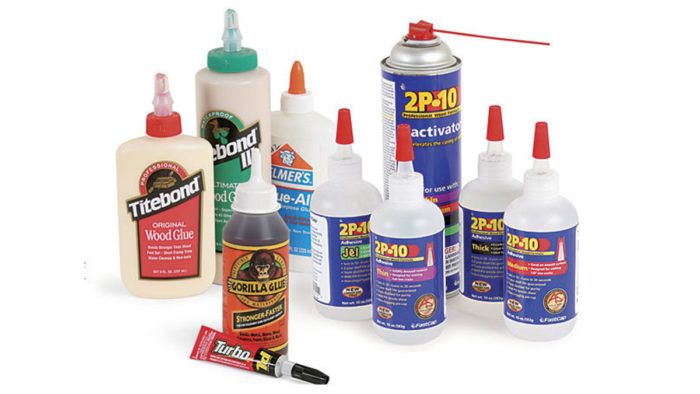
Shelves at hardware stores are flush with glues, but for everyday job-site use, it’s best to consider just a few categories: polyvinyl acetate (PVA), polyurethane, and cyanoacrylate (CA). All three types of glue should have a place in your toolbox, but understanding the properties and strengths of each type will help you to make the best choice for the job at hand.
PVA glue’s performance varies
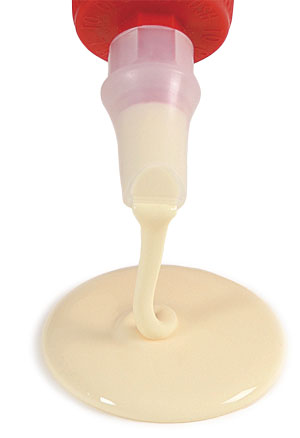
Polyvinyl-acetate glues encompass a range of products from Elmer’s white glue to Titebond III, a yellow glue designed to be used in extreme outdoor conditions. PVA glues are classified into three categories based on their water resistance.
Type-III (not water resistant) PVA glue consists of as much as 50% water and cures as the water evaporates. Glued surfaces must be clamped together until they reach 15% to 20% of their bond strength, generally in about an hour. It can take as long as 24 hours, however, to reach full strength.
Type-I (waterproof) and type-II (water resistant) PVA glues, such as Titebond II and III, contain water, but also strands of polymers that become entangled and chemically bonded to perform better in exterior conditions. These adhesives demand the same clamp time as type-III PVA glue, but generally have a longer open time and bond at colder temperatures.
Water resistance aside, there’s little difference in the strength of the joint made with any type of PVA glue. They all can resist forces around 3500 psi to 4000 psi. PVA glue can be cleaned up with water. Once it’s dry, you can scrape or sand away excess glue.
Best uses: Type I and II – exterior trim, outdoor furniture; type III – cabinetry, interior woodwork and trim
Cost: $5 to $9, depending on bottle size
Polyurethane glue is truly multipurpose
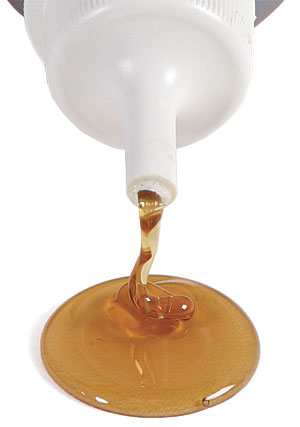
Polyurethane glues like Gorilla Glue and PL Turbo outperform PVA glues in several applications, such as bonding foam, stone, concrete, and ceramics.
One benefit of polyurethane glues is that because they are not water-based, they are not drawn into wood pores as drastically as PVA glue. For this reason, wood joints glued up with polyurethane accept stains and clear finishes better than with other types of glue. Polyurethane glues also enable you to glue up pieces even after a finish has been applied.
Because polyurethane glues cure by a chemical reaction triggered by moisture, they work well on wood with high moisture content or on oily woods, where PVAs have a hard time bonding. Polyurethane glues generally take six to eight hours to reach full strength and require the workpiece to be clamped for a proper bond. The clamps usually can be removed after about four hours.
The cured strength of polyurethane glue is slightly less than that of PVA—generally around 3000 psi—but still plenty strong for most any home-building application.
Prior to drying, polyurethane glue can be removed using solvents such as mineral spirits or acetone. Once the glue has cured, you can scrape or sand away squeeze-out.
Best uses: Oily woods, finished components, nonwood materials
Cost: $12 to $16, depending on bottle size
Cyanoacrylate glue creates an instant bond
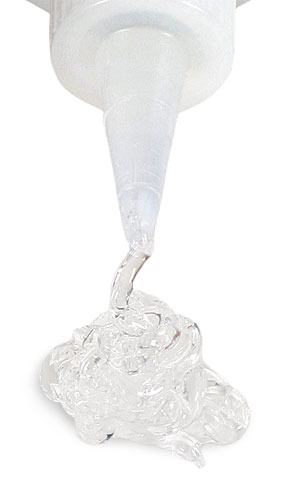
Not all CA glues are created equal. Some are one-part systems (Krazy Glue), and others require an activator to set up properly (2P-10). You also can buy CA glues in a wide range of viscosities, from thin versions that bond in as little as 10 seconds and cure at 30 seconds to thicker gels that have about a 10-minute open time and require clamping.
Marketed as an all-purpose glue and recognized most often as Super Glue, CA glue bonds to most any surface. It’s more expensive than PVA or polyurethane glue, which means that it is seldom a smart choice for bonding large surface areas.
Many trim carpenters swear by CA glues for their strength, speed, and ease of use. If you’re working on a crown miter joint, for instance, you can apply the glue to one side, the activator to the other, then simply hold the joint in place for a few seconds until the glue bonds.
One downside of CA glues is that they are brittle, so they are more likely to fail under impact. But the strength of CA glue is not far behind PVA glues, with some capable of withstanding up to 4000 psi. Cleanup of CA glue requires a solvent, such as acetone, prior to curing. After curing, you can scrape or sand away squeeze-out.
Best uses: Trimwork, furniture repair
Cost: $10 to $23, depending on bottle size
Photos by: Rodney Diaz







View Comments
Thanks for sharing the differences as well as find useful to for knowledge and for more on https://ezclick.sa/en/stationery-and-school-supplies/bags-cases-lunch-boxes.html