Choosing and Using a Miter Saw
Read expert ratings and reviews on the latest miter saws, and learn how to get the most from your miter saw with how-to videos and articles.
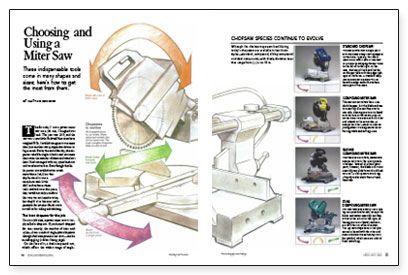
Get a comprehensive guide to choosing and using miter saws, also known as chopsaws, and learn how they differ in design and function. Plus, find tips on how to use these tool for accurate finish carpentry work such as crown molding and trim for walls, windows and doors. The guide covers standard chopsaws, compound-miter saws, sliding compound-miter saws, and dual compound-miter saws.
Browse all articles and videos on miter saws, or visit the FineHomebuilding.com Tool Guide for expert ratings and reviews on the latest miter saws, and post your own ratings and reviews for the tools you own. Visit the Tool Guide.
FOUR STYLES OF MITER SAWSOn most job sites, a power miter saw is simply called a chopsaw. Here are descriptions of four varieties of chopsaw.
STANDARD CHOPSAW
This saw pivots from a single point with the blade always cutting square to the table. Typically, this saw is used to cut miters across the width of a board by swinging the saw table to the left or to the right. In this case, the face of the board lies flat on the saw table with the edge tight against the fence. A standard chopsaw also can cut a bevel with the board on edge and with one face held against the fence.
COMPOUND-MITER SAW
This saw can cut miters like a standard chopsaw, but the blade and motor assembly also can flop over to one side, allowing you to cut a bevel with the face of the board lying flat on the table. You also can cut a miter and a bevel at the same time—a compound miter—which is used for joining crown molding as well as for framing roofs and cutting stairs.
SLIDING COMPOUND-MITER SAW
This tool can cut miters, bevels and compound miters like a compoundmiter saw. Instead of a fixed pivot point, however, the blade and motor assembly can slide forward and back on a rail. A sliding saw can cut significantly wider stock than a fixedhead saw.
DUAL COMPOUND-MITER SAW
This saw functions exactly like a sliding compound-miter saw, except the blade and motor assembly can flop either to the left or to the right, allowing you to cut bevels and compound miters in either direction. The key advantage here is that you can cut a board with the miter and bevel oriented the same way it will be installed, which can save a lot of head scratching.
Fine Homebuilding Recommended Products
Fine Homebuilding receives a commission for items purchased through links on this site, including Amazon Associates and other affiliate advertising programs.
Metabo HPT Impact Driver (WH18DBDL2)

Homebody: A Guide to Creating Spaces You Never Want to Leave
DEWALT 18v Cordless Multitool (DCS355)