previous
  • Meet the Fine Homebuilding Project House!
    Meet the Fine Homebuilding Project House!
  • 7 Small Bathroom Floorplan Layouts
    7 Small Bathroom Floorplan Layouts
  • 7 Solutions for Kitchen Layout and Design
    7 Solutions for Kitchen Layout and Design
  • 2012 HOUSES Awards
    2012 HOUSES Awards
  • 13 Door Design and Installation Tips
    13 Door Design and Installation Tips
  • Buyer's Guide to Decking
    Buyer's Guide to Decking
  • Guide to Paperless Drywall
    Guide to Paperless Drywall
  • How it Works
    How it Works
  • Energy-Smart Details
    Energy-Smart Details
  • 12 Remodeling Secrets Revealed
    12 Remodeling Secrets Revealed
  • Deck Design & Construction Showcase
    Deck Design & Construction Showcase
  • The Inspector Game: Decking Dos and Don'ts
    The Inspector Game: Decking Dos and Don'ts
  • Painting Ideas, Tips, and Techniques for a Professional Finish
    Painting Ideas, Tips, and Techniques for a Professional Finish
  • 10 Basement-Remodeling Tips and Techniques
    10 Basement-Remodeling Tips and Techniques
  • Fine Homebuilding: The Digital Issues
    Fine Homebuilding: The Digital Issues
  • Complete Kitchen and Bath Guide
    Complete Kitchen and Bath Guide
  • Outdoor Kitchen Design Inspiration
    Outdoor Kitchen Design Inspiration
  • Roofing articles, videos, tools, and materials
    Roofing articles, videos, tools, and materials
  • 9 Design Ideas & Tips for Concrete Countertops
    9 Design Ideas & Tips for Concrete Countertops
  • 15 Coffered Ceiling Design Ideas and Tips
    15 Coffered Ceiling Design Ideas and Tips
next
Pin It

Thermal-Resistance Ratings: U-factor vs. R-value

U-factor and R-value measure heat transfer and heat resistance, respectively; understanding the difference will help you select energy-efficient windows and insulation

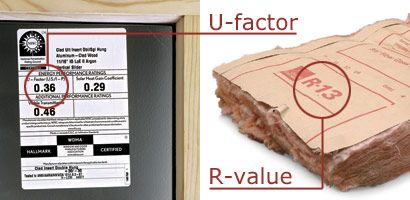
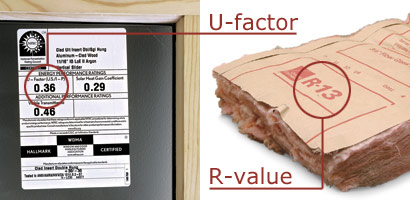
Both U-factor and R-value are measures of a material's insulating performance. The former is a measurement of heat transfer; the latter measures heat resistance.

U-factor

Generally used to compare the performance of windows, U-factor first was invented by engineers and scientists as a measure of the rate at which heat flows through 1 sq. ft. of material. The direct opposite of an R-value, a lower U-factor rating means that less heat will be lost.

U-factor ratings generally fall between 0.20 and 1.20. A window that has a U-factor of 0.40 or less is considered energy efficient.
R-value

Created as a way to sell insulation, R-value is a measure of resistance to heat flow. The higher the number, the greater the insulating value.

Because doubling the R-value cuts heat loss in half, adding R-1 to R-1 will make a big difference; but adding R-1 to R-30 will reduce heat loss by only about 3%.

A good installation technique is the key to getting a good R-value. For instance, R-19 insulation installed incorrectly probably will perform at a level of R-13.

 Bruce Harley is the author of Build Like a Pro: Insulate and Weatherize, published by The Taunton Press.
From Fine Homebuilding170 , pp. 112 April 1, 2005