Q:
With all of the discussion and controversy surrounding the question of removing collar ties, the 1998 international code does discuss “rafter ties” in section 802.3. But isn’t rafter tie just another way to say “collar tie”?
Darian Butler, Wakefield, RI
A:
Contributing editor Mike Guertin replies: Collar tie is a colloquial phrase that you usually won’t find in construction or engineering documentation even though the words are commonly used among builders, architects and homeowners. The correct phrase as used in textbooks and when specified is collar beam.
As I stated in my earlier Q&A response, international residential code does not require collar beams. However, in those cases when they are specified, collar beams are usually installed in the upper third of the roof between opposing rafters.
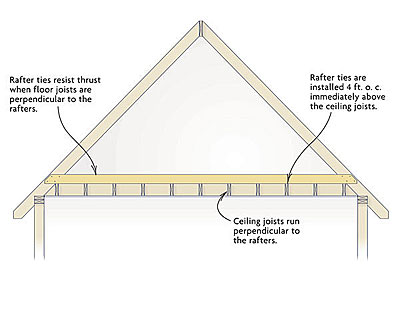
On the other hand, rafter ties are installed between opposing rafters as close to the top plate as possible. Common ceiling joists function as rafter ties when they run parallel to the rafters. However, when ceiling joists run perpendicular to roof rafters, rafter ties should be installed to resist the thrust that the rafters exert on the exterior walls.
Rafter ties amount to an additional framing member that runs above the ceiling joists and that connects opposing rafters. They are generally required every 4 ft., which means that you need a rafter tie only for every other pair of 24-in. o. c. rafters or for every third pair of 16-in. o. c. rafters.
Fine Homebuilding Recommended Products
Fine Homebuilding receives a commission for items purchased through links on this site, including Amazon Associates and other affiliate advertising programs.
Guardian Fall Protection Pee Vee

Peel & Stick Underlayment

Tajima Chalk Rite Chalk Line