Sizing Gutter Systems
A three-step approach helps you calculate the best size for your house
Gutters are essential to the longevity of most homes. Without gutters and downspouts leading rainwater away from the house, foundations become feedlots for mold that can sicken your family and rot your house. Once you’ve settled on a material, and a profile, you’ll need to pick a size. This procedure for sizing your gutter system is based on roof size, your area’s likely rainfall intensity, gutter volume and downspout size and frequency.
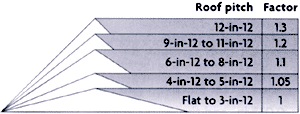 1. Calculate your roof’s watershed area — A roof’s watershed area isn’t obvious. Maximum rainfall is likely wind driven, so steep roofs may collect more water than flat roofs. To figure a roof’s watershed area, multiply its surface area by the appropriate factor on the table.
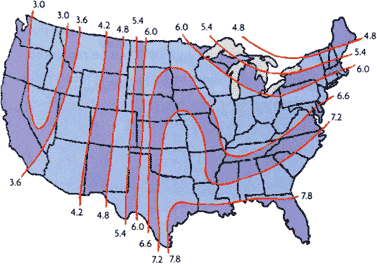 2. Find the maximum likely rainfall intensity — Residential gutters are often planned to handle the most intense five-minute burst of rain, measured in inches per hour, that’s likely to occur in a ten-year period. Find yours on the map.
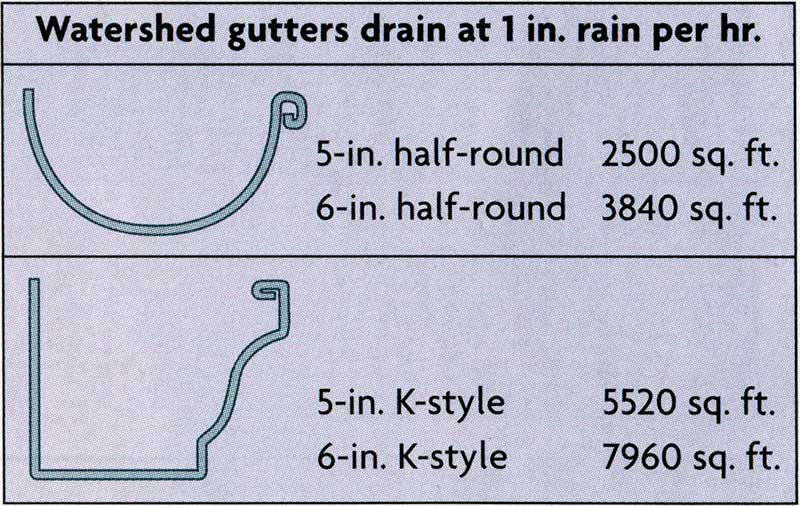
3. Determine the gutter needed to drain your watershed — Divide your favored gutter’s 1-in.-per-hour watershed (see the chart below) by the five-minute rainfall intensity (from the map above). This determines the maximum watershed level gutters can serve between downspouts. Pitch your gutters by 1/8 in. per ft., and you can multiply the watershed by 1.4.
 Each square inch of downspout cross section can drain 100 sq. ft. of watershed. So a 2-in. by 3-in. spout drains up to 600 sq. ft., and a 3-in. by 4-in. spout drains 1,200 sq. ft.
Going from one downspout to two doubles the watershed that a section of gutter can drain.
Sample house — An 8-in-12 pitch shed roof in Washington D. C. is 40 ft. wide, and its rafter length is 20 ft. The roof’s area is 800 sq. ft. The pitch factor for an 8-in-12 pitch roof is 1.1; when multiplied by 800 sq. ft., that gives a watershed of 880 sq. ft. The theoretical 5,520-sq. ft. watershed drained by a 5-in. K-style gutter, divided by Washington’s 6.6-in.-per-hr. rainfall intensity, shows a maximum watershed of 836 sq. ft. Close, but to be safe, the builder should either pitch the gutter, use a larger gutter or add another downspout.
Drawing: Dan Thornton
Fine Homebuilding Recommended Products
Fine Homebuilding receives a commission for items purchased through links on this site, including Amazon Associates and other affiliate advertising programs.
Plate Level

A Field Guide to American Houses

All New Kitchen Ideas that Work