Q:
On old-fashioned lamp plugs, both conductors are the same size, and the lamp works regardless of which way it is plugged in. On new plugs, the conductors are different sizes. I’ve been told this is to keep the polarity constant. What is polarity, and why does it matter?
Mike Lynch, via email, None
A:
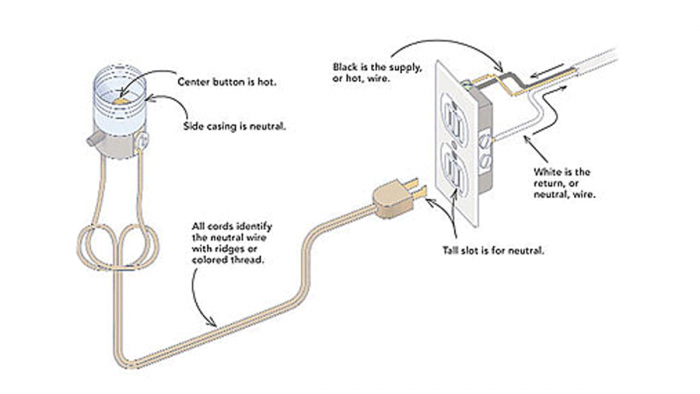
Clifford A. Popejoy, a licensed electrician in Sacramento, California, replies: Polarity refers to the two conductors of an electrical circuit. These conductors are called poles, as in the poles of a magnet. One pole is a supply conductor, and the other is a return. By convention, the supply is represented by a black wire, commonly called the hot wire. The return uses a white wire and is commonly called the neutral.
In modern receptacle outlets, one slot is taller than the other. This tall slot should be connected to the neutral conductor. The short slot should be connected to the hot. That’s normal polarity.
Modern plugs match these receptacles and correspond to wiring in lamps, appliances, and tools. A lamp is wired such that the neutral wire goes to the casing of the lamp socket, and the hot wire goes to the tab or button at the bottom of the socket.
Why is this routing path important? Safety. If you’re installing a new lightbulb without unplugging the lamp, you’re safer with the hot contact at the bottom of the socket rather than at the casing. Accidentally touching the socket casing is much more common than accidentally touching the button.
For a tool or appliance, the hot wire is fed through the switch. That means there’s only an inch or two of energized wire in the case of the tool or appliance when the tool is plugged in. If the polarity is reversed, virtually all the wiring in the case (including all the motor windings if there’s a motor) is energized at 120v whenever the tool is plugged in. Damaged insulation on a wire or a motor winding could energize a metal tool case, creating an electrocution hazard.
If the tool is connected to a GFCI-protected outlet or circuit, the GFCI should trip to protect the tool user, but sometimes GFCIs fail. Correct polarity is another way to put the odds in your favor.
When replacing the cord or plug on an appliance, be sure to get connections right: The neutral wire is the identified conductor. It may have ridges running along the length, or there may be a colored thread running between the wire and the insulation. Don’t go by the writing on the wire. A quick continuity test to make sure is never a bad idea.
From Fine Homebuilding #166


















View Comments
Nice article