Q:
How many recessed lights are required for a 14-ft. by 18-ft. kitchen?
Delbert Nishimoto, via email, None
A:
Nancy McCoy, a lighting designer in Novato, California, replies: That’s a pretty broad question, but it offers a chance to give an overview of lighting-design concepts. First, you need at least a couple of types of lighting in any room (general lighting and task-specific lighting, in this case), or you’ll have unwanted shadows in the work zone. The lighting levels are affected by ceiling height and room color. Higher ceilings and darker walls soak up more light, so you need to account for these factors. Let’s look at a simple white room with an 8-ft. ceiling as one example.
The National Kitchen & Bath Association (www.nkba.org) suggests a general-lighting level of 30 foot-candles and task lighting of 75 foot-candles. (A foot-candle measures light per square foot. A sunny day can be as bright as 10,000 foot-candles; the light from a full moon is about 1 foot-candle.)
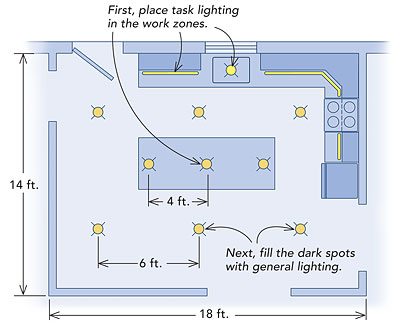
You can use fixtures mounted in the ceiling, also known as downlighting, for general lighting, task lighting, or both. To get the required 30 foot-candles with 4-in.-dia. recessed lights, look in the back of a lighting catalog, such as Juno (www.junolighting.com). The chart says you need to space 4-in.-dia. fixtures about 6 ft. apart and use a 50w MR16 low-voltage bulb (a small reflective floodlight). For task lighting, space the fixtures 4 ft. apart.
That works out to be a lot of watts. Here in California, we’re required to use compact fluorescent lamps for at least 50% of the lighting wattage for new and newly renovated kitchens. And 75 foot-candles can be too bright in some situations, so I prefer to control lighting circuits with dimmer switches. I like Juno fixtures with dimmable ballasts for compact fluorescent lamps. For your 14-ft. by 18-ft. kitchen, start with the task lighting, then fill in the general lighting (see drawing). By the way, I prefer 5-in.-dia. fixtures because the diameter is better suited to an 8-ft. ceiling height.
Now, let’s go a little deeper and talk aesthetics. A kitchen lit only with downlights will be a bland room. It’s better to incorporate a few types of lighting in the room to meet your needs. Undercabinet lights and dropped pendant lights over an island can provide task lighting; recessed fixtures and sconces along walls can fill in the rest of the general lighting. For a more in-depth look at kitchen lighting, see my article The Well-Lit Kitchen in FHB #135 (pp. 68-73), and also visit The Lighting Research Center at www.lrc.rpi.edu.