Q:
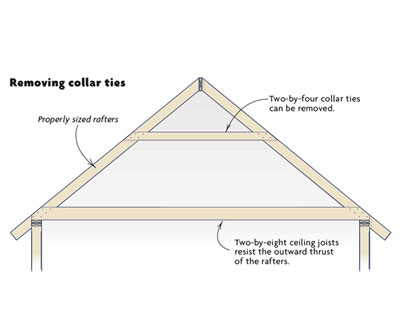
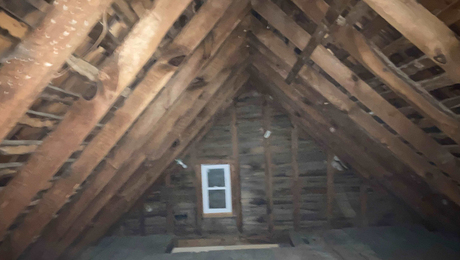
We would like to turn the attic space of our garage into a storage loft. Currently, the ceiling joists in the garage are 2x8s spanning 16 ft. 6 in., 16 in. o. c. About 3 ft. above each joist is a collar tie. Can we remove the collar ties to make this space usable for storage?
Jack Herrington, Bloomfield, NY
A:
Contributing editor Mike Guertin replies: I love this question. I love it because the answer is simple, although it will probably ruffle a few feathers among some builders and building designers. Structural engineers already know the answer to this question, so they won’t be surprised. I also love this question because I get paid my regular rate for one sentence: Steve, based on your sketch, you can just tear out the collar ties.That’s it. Maybe I should explain a bit more and earn my keep.
Collar ties are practically worthless and are not required by the CABO or UBC codebooks. Most of today’s construction textbooks don’t even mention collar ties or show them in drawings anymore. Building codes require that the rafters themselves need to be adequately sized to support roof loading and that ceiling joists need to be fastened at lap joints to resist the outward thrust by the weight of the roof. Collar ties are the appendix of roof framing, an evolutionary dead end in home building hanging on by just a couple of nail points.
The only time collar ties do any good is when they are specifically designed to be functional by an engineer or architect and are installed with meticulous care by the framer according to detailed drawings. Such collar ties are usually designed to resist outward thrust when there are no ceiling joists or structural ridge to serve the function. In these cases, structural collar ties should be securely fastened to the roof rafters with through bolts and spike grids. This hardware connects the collar tie to the rafter; a half-dozen nails don’t do the job.
The ceiling joists that run between the exterior walls alongside each rafter are much better at resisting thrust provided they are fastened to the rafters as well as to the wall plates. I have to laugh every time I come across a set of house plans that shows collar ties between rafters above ceiling joists. I know right away that the plans were probably drawn by someone who doesn’t understand how collar ties function.
One word of caution: Your sketch shows the 2×8 ceiling joists spanning around 16 ft., much too far for anything but the lightest loads. If you do plan to store things in the loft, limit your storage to empty computer boxes, and keep things such as the engine block to your ’67 Camaro safely on the garage floor.
Fine Homebuilding Recommended Products
Fine Homebuilding receives a commission for items purchased through links on this site, including Amazon Associates and other affiliate advertising programs.

Protective Eyewear

Tajima Chalk Rite Chalk Line

Magoog Tall Stair Gauges

















View Comments
Hi...I was wondering if this holds true for older homes also? Mine was constructed in 1930. There are collar ties, but they are on every other rafter. They are old wood...maybe 3/4" thick 6-8" tall. I'd love to remove them, as they are going to be challenging to work around as I finish the attic.
Thanks,
Keith
Hi Keith,
I wish he would have replied to your comment years ago, because I am in the same predicament as you. I have a home built in 1932 with relatively dainty ties connecting the rafters. About 3/4" thick aswell. I'd like to remove them and I was wondering if you had gotten a resolution on your situation you commented about years ago?
Dexter