Q:
I read Rex Cauldwell’s article Ten Common Wiring Problems, hoping that he would address voltage drop in electrical lines. In today’s larger houses, it’s not uncommon to have wiring runs of many hundreds of feet. Could you provide a list of the voltage drop to be expected for various sizes of wire and how to figure it in a given situation?
Ronald H. Rowland, Swans Island, ME
A:
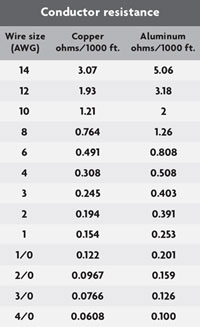
Rex Cauldwell, master electrician and author of Wiring a House, replies: All electrical wire has resistance, which is measured in ohms. The resistance changes depending on whether the wire is copper or aluminum, and it increases as the length of the wire increases (see chart). If the wire is taking away a substantial amount of voltage, at best the load will operate less efficiently, and at worst the load can burn out. Optimally, the wire you use should keep voltage drop down to 3% to 5% of the input voltage.
Here’s an example.At the end of your driveway, you need to put a light that pulls 5 amps. Your driveway is about 500 ft. long, so the wire length is 1000 ft. (500 ft. to the light and 500 ft. back). If you want to use less expensive 14-ga. copper wire, the resistance would be 3.07 ohms multiplied by 5 amps equaling 15.35v of resistance across the length of the wire. In a standard 120v circuit, you’d be left with 104.65v, a 12.8% drop, which is unacceptable.
The resistance for 12-ga. wire drops to 1.93 ohms for the same distance. But this resistance multiplied by 5 amps equals a voltage drop of 9.65v, or an 8% loss, better than 14 ga. but still too high. The voltage drop for 10-ga. copper (1.21 ohms per 1000 ft.) works out to 6v, or about 5%, which is acceptable. So to wire the light at the end of the driveway in this example, you’d need 10-ga. copper wire.