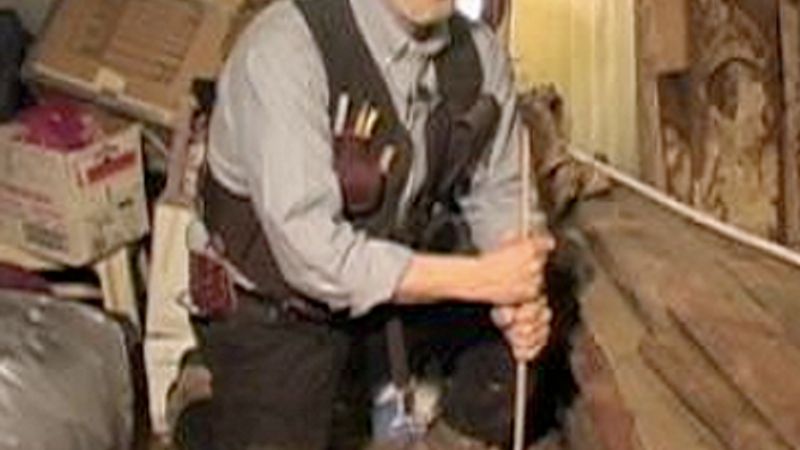
John Ross from Bethel, Conn., writes:
The walls in my old colonial have only a 1-in. cavity between the two planes of lath, and much of that space is obstructed by plaster keys. When I wanted run new electrical wires, I couldn’t use a snake because it kept getting hung up on the globs of plaster inside the walls. To make a channel for the wire and to provide something to hook the wire to so I could pull it through the wall, I used a 3/16-in. by 1-1/2-in. piece of lath I purchased at the local home store. Now when I want to run wire, I locate were I want my wire to run, either from up top or down below. Then I shove the lath through the cavity, breaking the plaster keys as I go. Because of its shape, the lath keeps to a straight line. It sometimes takes some work to get the lath to an outlet or light-switch location, but once it’s there, I simply attach my wire to it and pull it back through the wall.













View Comments
When pulling NM-B wire, it will make the pull much easier if the wire's sheath is wrapped with tape up to the conductor. It is not done in the video and you can see that the sheath is pulled back thereby increasing resistance.
Not sure this is a good idea. The keyways provide an important function - they hold the plaster to the lath. Once you start to break them off, you create a weak spot that is more prone to cracks and the plaster separating from the lath.
There's a reason for the term "pulling wire", because you PULL wire, not PUSH it.
The author used the term "smake". I assume he means a fish tape. For those who don't know, a fish tape is a narrow spring steel flat wire in a reel used to PULL wire through conduit. It will make for a very frustrating day if you try to fish a wall with one, whatever the cavity depth. Because of the natural curl it will just coil up in the wall. Another case of using the wrong tool for the job.
Here's the method I've used for 30+ years.
1. Mark the location of the outlet box, and cut a hole in the wall to accept the outlet box. Be sure the box will fit correctly. (not sure what old work box you could mount with only a depth of 1")
2. Mount a work light so that it is shining into the opening.
3. In the area above (attic) locate the area directly above the outlet. If it's your own home, you can cheat by drilling an 1/8" hole into the ceiling above and inserting a piece of wire to be used as a locator. Easily plugged later.
4. If there is a top wall plate, with an auger bit drill about a 1" hole in line with the outlet box.
5. Look down your just drilled hole and you should see your work light shining into the opening. If you can't, you are either on the wrong side of a stud, or there is firestop blocking in between, making for a bad day.
6. Assuming you can see your light, attach about 6" of small chain to a length of nylon dry line. Lower this into the whole until you see the light on the chain.
7. Now go downstairs and pull the string through the opening. If you missed the alignment, you can use a magnetic retreiver with a flexible shaft to grab the chain.
8. Next, strip about 6" of sheath off of the NM-B. Cut the white even with the sheath, black about 2" longer, and leave the bare for the leader. As previously mentioned, tape from the bare to the sheath to ease the transition and eliminate the hump.
9. Attach the bare leader to the chain.
10. Go back up into the attic and PULL the wire.
It probably took longer to write this than to actually do it.
Awesome tip. Thanks Chuck. Great video production too, FB staff. Easy-to-understand video clips to go with well-worded dialogue. Not an easy task for a chore that mostly occurs inside a wall.
I always try to use an armored metallic cable for pulled wires in existing construction even when NM-B wire is allowed by code.
First, because of its flexible nature it is easier to pull. Yes I know the connectors are a pain.
Secondly, a new pulled wire is not protected from future intrusion as is wire that was installed correctly in the original construction. How many times do we find hot wires when demolishing walls or ceiling with the use of a finely tuned sawsall blade? Boy I sure love it when I find conduit or armored cable.
For a narrow wall, I feel the tip is a good solution. Knocking off 1-2" of plaster keyway is probably not consequential but if the plaster was in poor shape to begin with I could see potential problems.
The video showed a good idea. However as a couple of the previous posters alluded to, breaking keys can lead to disastrous results. I've tried it and next thing I kow there is a big patch of finish plaster on the floor and I have a major repair job to do after the new outlet is in place.
Is anyone regularly using one of those new cameras with LEDs to view prospective cable runs, and then pull new cable in place?
Sorry but I have to agree with Jjwcrawford on this one it is not a good idea to go breaking off plaster keys in most old houses they have enough problems with the old plaster as it is to go start breaking it up from behind.
This tip may make the electricians job easier but it is the same as a plumber just hacking away at framing to make running pipes easier. You do not sacrifice the structure or finish of a old house just to make the job of adding modern utilities easier.
And sometimes doing it does require some destruction. But it is better to just go ahead and make the mess and repair it then to cause hidden damage and leave.
In this case the electrician may think he saved him self some patch work but in reality he caused hidden damage that will eventually lead to someone else having to do a repair in the future. He may not care since he is gone and his check has already cleared. But it is not the way to do business.
I've done lots of electrical and security renovations. Old House Guy is dead on the money. A couple of generations ago, my boss told me (as he was getting ready to send me out into the field as an apprentice for the first time), "Hook up with an old timer. LISTEN to him...learn from him. He didn't make it in this business as long as he did by being stupid." Words to live by...then and now. The ball-chain trick is spot on. One house that's a claim to fame is the second oldest house in the Northwest Territory in Marietta, Ohio. Not only was it a challenge...but honoring the Historic Preservation folks' wishes was a huge undertaking. The ball chain trick worked like a champ in that house...and nothing was destroyed vis-a-vis plaster and lath, either.
There’re some great tips in these comments. I’m in agreement with some others here that Old House Guy’s tip of a chain on a string is a great idea. I especially like the part about using a magnet to retrieve the chain. I’ll have to try that next time I run some wire.
As far as the lath tip goes, there are a couple reasons why I like it and we decided to include it in the Better Way tip series. First, the lath is skinny enough to slip past many obstructions that you find in old walls, insulation, newspaper, corncobs (and other rat debris), older wires, and yes plaster. Yet because of the shape, it’s highly controllable. You can move it from side to side, back and forth and in general probe around to find a way through. This makes it useful in a variety of circumstances including times when the only way into a wall cavity is from below.
Second, like Old House Guy’s tip, it uses something that is inexpensive to solve a problem in a clever or unexpected way. This is at the heart of the There’s a Better Way tip series.
As far as busting keys off, I’ll own that one. It is ill advised to go busting off the keys without a good reason. That said, every situation has to be assessed. Remodel, especially in old houses is a messy business. Do I think clearing a 11/2-in. wide path is going to jeopardize the plaster strength? No. The plaster is on the wall and under compression. However, I probably should have warned people that if the plaster is unsound or they get crazy with the tip and have a key-busting party with their friends they might run into some problems.
This may not apply but I was visiting my son in Seattle and purchased a Snake ( nylon with both an eye and a battery powered light). You could remove the eye and replace it with a small battery and the red bulb. I ran over 150 ft of Romex over ceilings and thru walls with it. Boy you also see the red light to make sure you went in the right direction. I have tried for 3 years to get a replacement of the snake, so far I have not found it again!!!!
Interesting idea, though I appreciate the caution about breaking the keys. Many old plaster walls I have dealt with have broken keys already and this might bring about a lost of integrity of the plaster. You just need to use caution.
My foremost criticism, however, is the fact that I have rarely had a nice rectangular opening above the target opening in the wall below to allow access of a wide, narrow slat. Almost always, there is a solid plate. This usually means drilling a 3/4" hole that is too small to admit a slat. While a snake could fit in the hole, the keying could certainly prevent it from passing because of the stiffness of the snake. However, I have many times successfully used utility chain for hanging fluorescent fixtures to pull the wire from the receptacle hole. This easily fits through the hole drilled in the plate, and, by "jigging" the chain as you let it down, it can descend in the wall space. Obviously, this takes some planning and patience, but it does work most of the time.
Snaking NM cable through old work spaces is always challenging, and having another potential solution in the tool box such as the slat idea is always welcome. Thanks!