Heat-Recovery Ventilator
Heat-recovery ventilators can keep up to 80% of the energy in exhaust air inside a house, saving conditioned air and the money spent to heat or cool it.
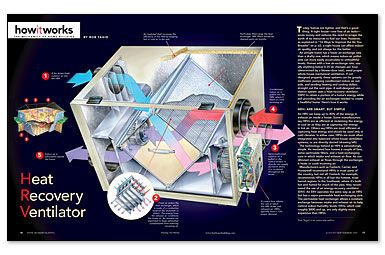
Click the image above to download a PDF you can enlarge.
Today, homes are tighter, and that’s a good thing. A tight house—one free of air leaks— saves money and reduces the need to scrape the earth of its resources to fuel our lives. However, as explained in “16 Ways to Improve the Air You Breathe,” a tight house can affect indoor air quality, and not always for the better.
An airtight home has a lower air-exchange rate than a drafty one, which means indoor-air pollutants can more easily accumulate to unhealthful levels. Homes with a low air-exchange rate, usually anything below 0.35 air changes per hour (determined by a blower-door test), need proper whole-house mechanical ventilation. If not designed properly, these systems can be grossly inefficient, pumping conditioned indoor air outside, and sending heating and cooling dollars straight out the vent pipe. A well-designed ventilation system uses a heat-recovery ventilator (HRV) to retain a portion of a home’s energy while still providing the air exchanges needed to create a healthful home. Here’s how it works.
HRVs are smart, but simple
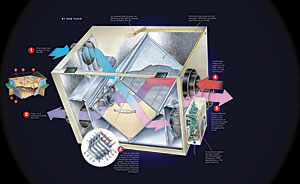
An HRV can keep up to 80% of the energy in exhaust air inside a house. Some manufacturers say HRVs are as efficient at reclaiming the energy in cool air as they are at capturing the energy in hot air. Others say HRVs are most efficient at capturing heat energy and should be used only in cold climates. In either case, HRVs are most often integrated into balanced whole-house ventilation systems, or are directly ducted.
The technology behind an HRV is astonishingly simple. An insulated box houses a couple of fans, some particulate filters, and a heat-exchanging core in which intake and exhaust air flow. As conditioned exhaust air flows through the exchanger, it heats or cools incoming air.
Manufacturers such as Fantech, Carrier, and Honeywell recommend HRVs in most parts of the country, but not all. Fantech, for example, recommends HRVs in all but the hottest, most humid regions. In the Southeast, where it’s both hot and humid for much of the year, they recommend the use of an energy-recovery ventilator (ERV). An ERV operates the same way as an HRV, but has a vapor-permeable heat-exchanging core. The permeable heat exchanger allows a moisture exchange between intake and exhaust air to help control indoor-humidity levels. ERVs, which cost roughly $800 and up, are only slightly more expensive than HRVs.
Drawings by: Don Mannes