Driving concrete nails
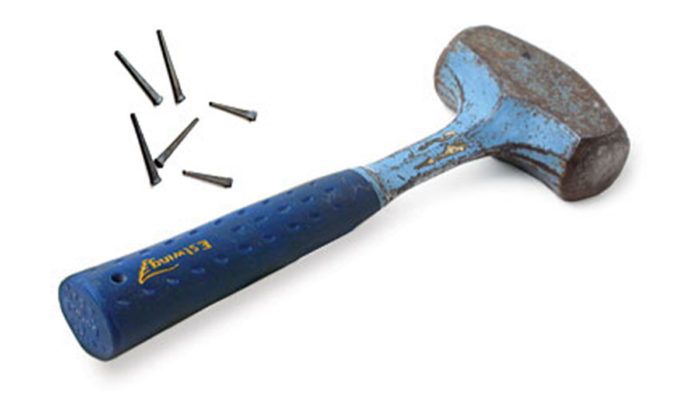
Most hammers I’ve seen come with a label warning against using them to drive hardened-steel nails such as concrete nails. What is the correct hammer to use for driving concrete nails?
– Isaac Clark Jr., Durham, NC
Larry Haun, a carpenter in Coos Bay, OR, and author of The Very Efficient Carpenter, replies: Driving hardened concrete nails is sort of like building good scaffolding. Everyone knows what they should do, but few people do it. My knowledge about hitting hard steel against hard steel came, like most of my education, the hard way. I still carry a small piece of metal embedded near a knuckle from hitting a concrete nail with my framing hammer.
The heads of framing and finish hammers are typically hardened to between 55 and 60 on the Rockwell hardness scale, which is quite hard and also brittle. These hammers are designed to drive common and finish nails made of softer steel. When a hardened-steel hammer strikes a hardened-steel concrete nail, chips can break off the hammer face and become deadly projectiles.
The answer is to use a hammer with a head made of softer steel than concrete nails. Hammer maker Gerald Dalluge (714-546-5298; FHB #113, p. 122) says that it’s better to drive concrete nails with a ball-peen hammer or a small sledge like the ones used in the auto industry or in construction to beat on metal or concrete. These hammers are softer, usually hardened only to between 45 and 50.
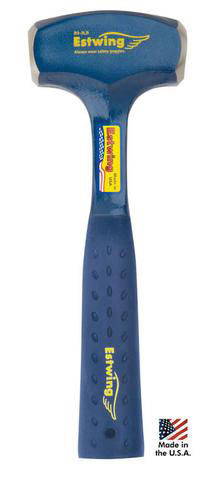 The folks at Estwing (www.estwing.com) said that their 2-lb., 3-lb. and 4-lb. drilling hammers can be used for striking chisels, cat’s-paws and star drills as well as for driving concrete nails. They couldn’t tell me where these hammers fit on the hardness scale, but they must be softer than concrete nails. I suspect the same is true with a lot of other small sledgehammers on the market.
Because of the danger of flying hammer chips when driving concrete nails, be sure to wear eye protection, and warn others who might be working around you to do the same. If the hammer you’re going to use has a smooth face, I recommend roughing it with coarse-grit sandpaper to keep it from slipping off the nail head. I also would try driving concrete nails with softer blows just as when driving a regular nail through a piece of hardwood.
Concrete nails drive more easily into green concrete that hasn’t reached its final hardness. Trying to drive a concrete nail into fully cured concrete is not easy, especially if you try to go more than 3/4 in. deep.
Photos: Estwing