Is green building too expensive?
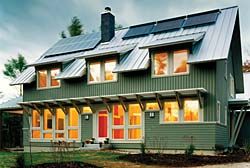
How much higher do energy costs have to rise before people will pay a premium for a house that is LEED-certified?
Meyersphoto.com
My wife and I decided not to have children. We just couldn’t make the numbers work. From prenatal care through college tuition, we were looking at half a million dollars. Minimum. And it would be 25 years before that investment would even begin to show a return, let alone pay us back. Kids made no sense.
I’m joking, of course. Looking just at the monetary cost of having kids not only ignores other costs—a parent’s time, for instance— but more important, it fails to account for the tremendous emotional rewards paid out over a lifetime. No one in their right mind would decide whether to have children based solely on the financial equation. The issue is more complicated.
So is green building.
Green is becoming a bad word
The first problem with any discussion of green building is the term itself. Green is becoming a divisive, political word, like liberal and conservative. Ironically, green is associated with liberal, while the root of conservative is conserve, which means “to protect from loss or depletion; preserve.” We need to think about and talk about and even argue about how to build better, more-sustainable homes. We don’t need a word so polarizing that it shuts down the debate.
Another problem with the word green is that its meaning is being perverted, and ultimately lost, in the interest of marketing products and services. Recently, I have been asked to accept as green a jetted spa/tub designed to require fewer toxic chemicals for cleaning, and a $3000 stainless-steel outdoor griddle that uses less propane than a conventional grill.
In what universe did it ever make sense to build a house that wasn’t energy efficient?
But my biggest complaint about the word green is that it somehow legitimizes the alternative. In what universe did it ever make sense to build a house that wasn’t energy efficient? Or where the air inside wasn’t clean and free of mold? Or where the detailing wasn’t carefully crafted to ensure that the building would last a long time?
Our grandparents and great-grandparents built homes that took advantage of the sun’s heat and the earth’s insulating qualities. They used natural materials available to them locally, but they didn’t call it green building. Back then it was just common sense; it was smart building. But for now, at least, we seem to be stuck with green.
There’s no such thing as a green house
Green is a relative concept, not an absolute one. Even the best green homes built today aren’t really green, which is to say they’re not sustainable. A 1500-sq.-ft. house producing all its own energy from renewable sources is likely still filled with products that took more from this earth—in their manufacture and transport—than will ever be returned.
How far back in time would we have to go to find an example of a truly sustainable house, one whose construction and operation did no harm to the environment? It would have to be built from 100% renewable resources. It would have to run on renewable energy, and it would have to be, essentially, compostable, able to return harmlessly back into the earth from which it came. Would it be made of stone, timber, adobe, or straw bales? A teepee would certainly qualify, one made of saplings and animal hides and heated with an open fire. But I don’t imagine any of us willingly returning to such an elemental existence any time soon, however green it might be.
“If you waste less lumber on the next house you build, you could certainly claim it’s greener than your last house. But does that make the house green or you a green builder?”
For now, we need to accept that none of us is going to build or live in a truly green, sustainable house, one that does no harm to the planet. We have to focus on trying to do less harm, which leaves us with two questions: How much less? And who decides?
If building practices range from completely irresponsible on one end of the spectrum to completely responsible (and sustainable) on the other, we have to wonder where along that line green building begins. If you waste less lumber on the next house you build, you could certainly claim it’s greener than your last house. But does that make the house green or you a green builder?
The current codes in this country were not designed to define where green building begins, and nobody thinks they do. Right now, the U.S. Green Building Council’s LEED-H program and the National Association of Home Builders’ Green Builder Program are both trying to establish minimum requirements for a green house. Of course, the two organizations don’t agree, and LEED’s standards are generally viewed as being stricter and more expensive.
Expensive doesn’t mean unaffordable
It is another irony of our modern times, and of our definition of green building, that green is seen by some as a luxury only the wealthy can afford. Two hundred years ago, it was the poorest people who were living the greenest lives. Back then, you needed money not to be green, but to afford the oversize house and the imported marble.
The common argument against green building—that it costs too much—relies on a narrow definition of cost, typically reducing it to the amount of money paid up front. It ignores other costs, those that are less immediate and less visible, and it ignores any possible rewards. Yet the same people who dismiss photovoltaics as too expensive, who say the payback period is too long, happily plunk down money on luxury items—a Porsche, say, or a hot tub—without ever asking, “Where’s the payback?”
But because investments such as photovoltaics or extra insulation really can pay us back (and ultimately save money by reducing energy costs), because this is possible, many people focus only on the financial equation. They consider an investment in energy efficiency like any other investment. If the payback on solar panels is 15 years and they might sell the house in five, they don’t buy the panels. If they plan to keep the house, but the same money invested in the stock market would net a bigger return in 15 years, they buy stock.
Cost is not such a simple issue. What is the cost of your house? Is it the $350,000 price that you agreed on with the seller? Or is it the more than $796,000 you will pay over the course of a 30-year mortgage? And what about fuel bills over 30 years? How do they factor in to the cost of your house? Even these questions, which suggest that cost is more than just a number on the price tag, are still simple financial equations. When you consider the environmental costs of building or operating a house, things become complicated quickly.
“Before we can argue intelligently about whether the benefits of green building are a fair exchange for the price, we have to understand the true cost of building any other way.”
Last year, the British newspaper The Observer reported that some clothing sold at Gap stores was being made in New Delhi sweatshops by children as young as 9 years old and working 16 or more hours a day. The Observer referred to this discovery as “the tragic consequence of the West’s demand for cheap clothing.” No one intended this consequence, not even the folks running Gap Inc. No one thought that child labor was a fair exchange for an inexpensive shirt. It happened because in this complex global economy, it is hard to know the consequences of our choices. But once we do know, we can decide for ourselves what is a fair exchange. Once we know that child labor is part of the cost of an inexpensive shirt, most of us will happily pay a little more for a shirt that might otherwise have seemed too expensive.
It’s no great leap for me, then, to wonder about houses, which are considerably more complicated and more expensive to make than shirts. What unknown costs lurk among the wires, pipes, studs, tiles, carpets, and cabinets? In the past, we discovered the dangers of lead-based paint and stopped using it. We learned the connection between asbestos and lung disease and found alternative materials for insulation and siding. Once we understood the importance of our wetlands to surrounding ecosystems, we stopped building on wetlands.
But what hidden costs, what potentially tragic consequences, have we yet to discover? What new ones are we introducing? Before we can argue intelligently about whether the benefits of green building are a fair exchange for the price, we have to understand the true cost of building any other way.
Value: the other half of the equation
When people dismiss green building as too expensive, they usually mean that adding green features—renewable energy, extra insulation, recycled materials—to the house they were already planning to build or remodel requires too much money. But such an evaluation hardly means that green building is too expensive. It simply means that some people value other things more highly. Those other things might be more square footage, extra bathrooms, a lavish kitchen, or a three-car garage. If a 4000-sq.-ft. house with green features costs more than you’re willing to pay, it might not be the green features that make it too expensive. It might be the size of the house.
Helped along by building codes and regulations, we have learned the value of many things that make our houses cost more. We have learned the value of digging foundations below the frost line, of expelling moisture from bathrooms with vent fans, of wiring homes for smoke alarms. And now we readily accept the worth of these additional costs.
Today, more and more people consider the cost of green building to be a fair price for a safe, comfortable, durable house that does less damage to the environment than a typical house. The effects of global warming, and the attention focused on them, make it easier to see the long-term cost of building so many homes that rely heavily on fossil fuels.
Even if you remain focused solely on money, green building’s value equation is constantly changing. With each increase in oil prices, photovoltaics and extra insulation will seem less expensive. I also wonder how soon the resale value of a house will be influenced substantially by its green features. How much higher do energy costs have to rise before people will pay a premium for a smaller house or one that is LEED-certified? Maybe we’ll reach a point where status is conferred not according to how big a house is but according to the electrical output of the photovoltaic array.