previous
  • The Self-Taught MBA: Inspired Reading
    The Self-Taught MBA: Inspired Reading
  • VIDEO: Stop Paint from Bleeding
    VIDEO: Stop Paint from Bleeding
  • Patrick's Barn: A Perfect Place for a Party
    Patrick's Barn: A Perfect Place for a Party
  • Replacing a Roof : Installing a Ridge Vent
    Replacing a Roof : Installing a Ridge Vent
  • How to Avoid Complicated Fractions
    How to Avoid Complicated Fractions
  • Your Guide to Energy Smart Homes
    Your Guide to Energy Smart Homes
  • How to Figure Out Concrete Volume with Sketchup
    How to Figure Out Concrete Volume with Sketchup
  • 7 Small Bathroom Layouts
    7 Small Bathroom Layouts
  • How To Make a Reciprocating-Saw Blade Guide Block
    How To Make a Reciprocating-Saw Blade Guide Block
  • The Inspector Game: Goofs on a Roof
    The Inspector Game: Goofs on a Roof
  • Seven Steps to Choosing the Perfect Circular Saw
    Seven Steps to Choosing the Perfect Circular Saw
  • Wanted: Plumber for a Bathroom Remodel
    Wanted: Plumber for a Bathroom Remodel
  • Top 10 Videos of 2011
    Top 10 Videos of 2011
  • Fine Homebuilding: The Digital Issues
    Fine Homebuilding: The Digital Issues
  • 10 Basement-Remodeling Tips and Techniques
    10 Basement-Remodeling Tips and Techniques
next

Dialing in nail placement

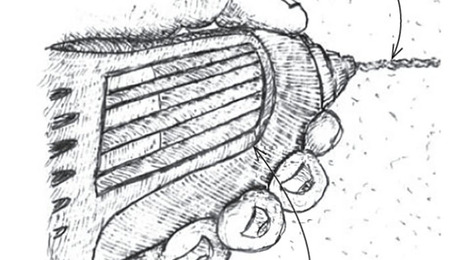
Finish nailers sure have come a long way from the old clunkers I grew up with. They even include a padded tip so that they won't dent surrounding wood. But rookie users often have a hard time seeing exactly where the nail will be driven through that fat padded tip.

Here at Seattle Central Community College, we remove the rubber or plastic tip and spray it with white paint. A fast-dry primer such as Kilz works well. After the paint has dried, the tip is remounted on the nailer, and the student carefully fires a nail into a piece of wood. By holding the tool steady after it has fired, you can mark cross hairs on the fresh white paint to show where the nail ends up in relation to the tip. We use a fine-tipped permanent marker for this. Now all you have to do is line up the cross hairs with your target, and the nail always goes where you want it to.

Dave Borgatti, Seattle, WA
From Fine Homebuilding 145, pp. 32 March 1, 2002