I was rereading some back issues of Fine Homebuilding when I came across Herrick Kimball’s paean, The secret life of masking tape. I too have used it in all the various ways that Kimball describes, plus a couple of others. For example, I use it to make labels on short lengths of electric cable. Before coiling them for storage, I mark their lengths on the strip of masking tape that keeps the coil from unwinding. Thus marked, it’s easy to find a suitable hunk of wire without unnecessary unraveling.
Masking tape is also good for clamping awkward pieces during glue-up. I mended a badly splintered chair spindle by gluing it and wrapping it with masking tape. Once the glue on the spindle cured, I sanded and painted it. That was 15 years ago, and the patch is still invisible.
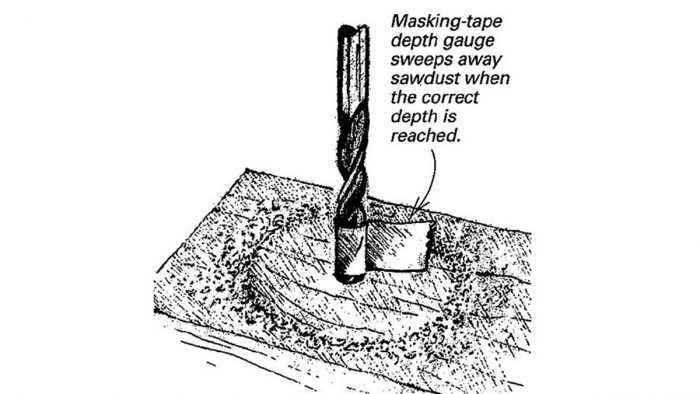
But my favorite use of masking tape is as a depth gauge. As shown in the drawing, I wrap it around the drill bit like a flag, with the ends sticking out. Then I bore my hole until the tape flag starts to sweep away the sawdust.
K. Burt, Corvallis, OR
Edited and Illustrated by Charles Miller
From Fine Homebuilding #100









View Comments
Thanks for that idea. I have to take up some plywood and want to use a small diameter hole saw with a jig (another idea from Fine Homebuilding) to cut around the nails and lift the sheets away. I'll flush cut the nails later but the tape wrapped around the hole saw will give me the correct depth every time.