Scott Razzino’s 26-year-old house in Atlanta has a damp basement. Although he’s directed gutter runoff away from the house and sealed obvious air leaks that would contribute to the problem, he’s still running a 65-pint dehumidifier to keep the moisture levels down.
He’d like to explore other options, and that’s the focus of this week’s Q&A Spotlight.
Among the options he’s quickly given, two broad strategies take shape. The first is tackling the problem from the inside of the basement. Assuming that some moisture is migrating through the concrete block, posters recommend an application of Drylok waterproofing.
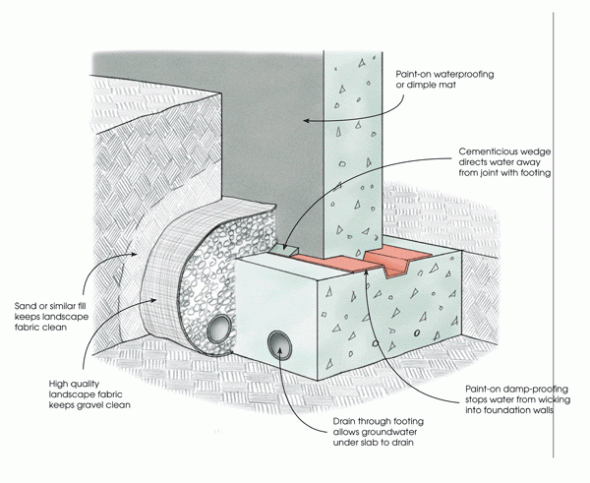
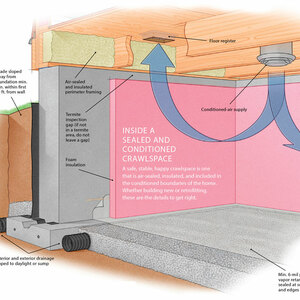
Other posters think the application of a waterproofing coat is treating the symptom, not the disease. What’s really needed, they say, is a correctly installed foundation drain that picks up water at the base of the wall and carries it off before it can do any harm.
Although that thinking has become standard fare, not all builders think it’s absolutely necessary. One North Carolina builder is convinced that basement water issues can be solved by handling surface runoff correctly.
Read the whole article at Green Building Advisor.
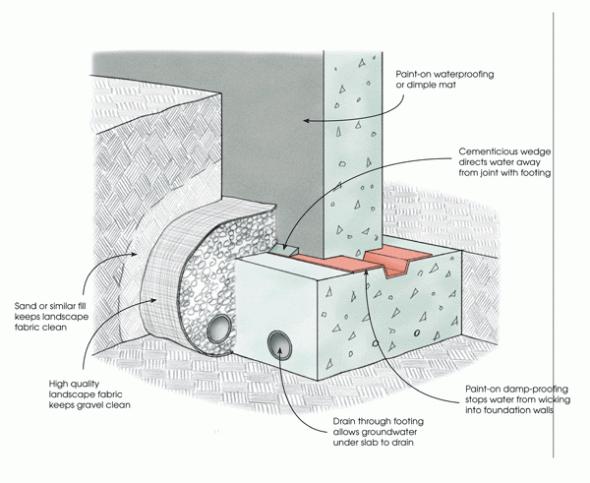
Keeping water out: When designed and installed properly, a foundation drain helps keep water out of the basement. Although they're standard in new construction, not all builders think they're really necessary.
















View Comments
The author has not identified the source of the water. Is it coming through the walls or floor, or is it simply condensing from the air?
Perhaps ground / foundation preparation has nothing to do with the problem, and will not fix it. Perhaps the solution is as simple as increased ventilation and a higher temperature in the basement.
Another common failing of tract-home builders is inadequate site preparation. For all we know, all the groundwater from the Applacian mountains flows through this yard- without there being any effort made to divert it around the house through grading and French drains. Again, simply coating the walls or adding a foundation drain isn't enough.
It's not 'green' to 'fix' something that has nothing to do with the problem.
I'd advise anyone thinking of investing in a dehumidifier to spend some time on an advice/informative site on dehumidifiers. Google shows up this site: Dehumidifiers for Home
Dont know if its worth a look.
http://dehumidfiersfor-home.com was the site, I dont know why it didnt show up in my comment.
I find discussion of french drains and all the other measures being suggested to be putting the cart in front of the horse, especially given the hot and humid southern area the problem is occurring in.
The first question to ask is how much outside, non-airconditioned air is getting into the basement space? If the answer is any at all, then there is the problem. Look at a psychometric chart of temperature versus humidity, and the problem becomes obvious.
For example, air at 90 degrees (hello, Atlanta!) and even 50% humidity becomes 100% humid when cooled to between 65 and 70. At 60% outside humidity, the dew point is reached at over 70 degrees.
However you do it, whether air conditioning or a dehumidifier, moisture has to be removed from the air relative to the outside, or there will be condensation problems given the temperature differences (between a basement and outside) in Atlanta in the summer. Even air conditioning, if outside air leaks into the basement, probably won't be fully effective in fixing the problem.
Chasing the structural problems is a waste of money unless you first rule out that simple physics is not the problem.
What ever you do make sure your dehumidifier will reset if there is a power interruption. Even with a battery back-up the models I purchased, (4 Sears), will not come back on even if the power is interrupted for one second. They are great dehumidifiers but so much for electronics.
What about removing shrubs next to house and replace with
small rocks and re-landscaping to get proper drainage