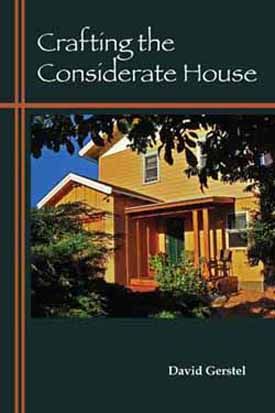
David Gerstel literally wrote the book on how to run a successful construction company. It’s called Running a Successful Construction Company (Taunton, 1991), and it’s arguably the best book available on the subject. How ironic then, that in his latest book, Gerstel admits, essentially, that after nearly forty years of residential building and remodeling he does not know how to build a good house. But like Socrates, whose awareness of his own ignorance made him the wisest person in Greece, Gerstel is perhaps the wisest builder around.
Most builders today don’t realize it, but none of us knows how to build a good house anymore. What we thought was good, especially from the standpoint of energy use and the environment, is nowhere close. Most of the houses we’ve built are too big, too expensive, too dependent on fossil fuels, too unhealthy for the occupants, and too damaging to the planet. Gerstel understands this, and so he set out to build a spec house in San Pablo, Calif., one that would challenge him to learn new ways of building and that would result in a better, more “considerate” house. He writes about that experience in his new book Crafting the Considerate House (Latitude 67, 2010).
Gerstel has four goals for the house. He wants it to be “healthy,” meaning free of formaldehyde and other toxic chemicals. He wants it to be “environment considerate,” an awkward phrase that he prefers to the overly abused “green.” Gerstel wants the house to be “dollarwise,” again trying to avoid the more common and somewhat loaded term “affordable.” And finally he wants the house to be “architonic,” a word he freely admits to making up. His willingness to do so is a little annoying, but his reasoning is hard to fault. Gerstel wants to build a house that not only looks good but that functions well, where doing laundry and moving groceries are efficiently and pleasantly accomplished. He also wants the house to feel “good under the hand—reassuring when you gripped a stair rail, turned a faucet or a door handle, or pressed your palm against a countertop.” Gerstel intends his new word “architonic” to encompass all of these qualities.
The book covers everything from the design of the 1,400 sq. t. house through, and including, its occupancy. Gerstel clearly and carefully explains every major decision from the stand point of his four goals. And perhaps most important, he introduces readers to the dangers of “single column accounting,” which he describes as a plague in the green building movement. Single column accounting is the tendency to focus narrowly on the costs or benefits of something without seeing the big picture. For example, proponents of bamboo flooring who tout its “greenness” as a renewable resource but fail to account for the environmental costs of shipping it from China are guilty of single column accounting. We all need to get better at recognizing and avoiding such faulty arithmetic.
When the house is completed, Gerstel rents it rather than selling it so that he can more easily monitor its energy performance. Hence the book includes details on energy bills (they totaled $648.43 in the second year), but Gerstel doesn’t stop there. He also includes thoughtful insight from his renters as to what they like and don’t like about living in the house. And he carefully explains what the house cost to build, even listing the hours of labor on various phases. Gerstel’s total out-of-pocket costs were $306,353, including the lot, permits and other services, but not including his own labor.
I wanted to love this book. Gerstel is an excellent writer who truly understands building. He can express what the rest of us know but can’t articulate. “Good framers are graceful and powerful athletes as much as they are craftspeople. They move with no waste of motion, making decisions as they move, hefting and placing boards, beam, and heavy hardware with rapid precision.” But as a whole, the book is uneven.
In an effort to add drama to the story, Gerstel introduces characters with a novelist’s flair. For instance, there’s the young, but game apprentice Ryan, whom Gerstel finds kneeling out by the curb one particularly hot day. “He looked up at me, wiped his mouth, grinned, and said ‘I told you I would work till I vomited.’” The problem is that this isn’t a novel and the characters don’t get developed. They appear, capture your interest and then disappear, just like the subs on a real job site. That may be real, but it’s also annoying.
It is also unclear at times who the intended audience is. Sometimes the book seems to be aimed at builders, as when it details how to frame corners for maximum insulation with minimal wood. Other times Gerstel carefully explains things, such as OSB and KD lumber, that any builder would know. So in the end, I didn’t love this book, but I do love Gerstel for writing it.
The home building industry is in a dangerous place right now. Just about the time that we had begun to understand the need to build better, more sustainable houses, we got hit by a horrific recession. Now builders are so desperate for work they can’t afford to be particular about what they build, they just want something to build. But if there’s any hope of moving on from the sub-prime mortgages and the McMansions that got us into this mess, then we need worthy examples of what to build. We need more “considerate” houses like the one that David Gerstel built. And we need more veteran builders who understand the problems we face—thoughtful, articulate people willing to try their best, explain their thinking, evaluate the result and then commit to doing better next time. We need more builders like David Gerstel and more books like Crafting the Considerate House.
–Kevin Ireton, editor at large












View Comments
I am new to your magazine.. It was suggested that I write to you and tell you what a 75 yr old widow decided to do and is doing it! In Las Vegas! I am building a Senior Smart House-the home that cares for you! When finished it will be open on weekends for Seniors/Contractors/Newlyweds to tour and to see how this kind of home can save you money on a monthly basis to live in. I am working with Direct Buy and Lowes for discount on prices for items to build my home. I am looking for appliances, that are smaller and more efficent than the normal size family appliances I now use. I need under the counter kitchen refrigerator/freezer with ice maker. I am using a drawer size dishwasher not normal size. Saves on water and power. Using induction stove top so I don't accidently burn myself due to embalance or use from a wheelchair. Windows have blinds inside them, no curtains or outside blinds to clean, just class. Smart techology scaled to be security seen via tv for outside cameras, opening doors and locking them. Turning on/off lights. Sensors thruout the house so numb fingers and feet don't need strength (as a Senior) to move things or open drawers/doors etc. No doors over kitchen shelves, can see items and pull out rack or sliding rack to pick up what you need. Nothing hidden in case you forget what door it is behind. Pocket doors where a room needs privacy otherwise the whole house is open and you feel free to breathe! No little rooms you feel smothered in! I would love to show you my home. Or read my ideas from the Review Journal Nov. 13th issue, Las Vegas newspaper. Love to hear from anyone that has ideas to offer or questions I might be able to answer. Having people using wheel chairs to come tour so they can see sensors are used in kitchen and bathrooms for water or whatever assists them to make life more comfortable.
Thanks, Kevin, for yet another thoughtful piece of journalism.
I was particularly struck by your observation, "Now builders are so desperate for work they can’t afford to be particular about what they build."
Even well-established builders are scrambling for work. And one wonders, given the ferocious pressure to low-ball bids and cut costs, if green building practices will come under the knife because their up-front costs are typically a big higher than construction-as-usual.