
How To Use a Japanese-Style Pull Saw
Pull saws aren't everyday tools, but they can come in handy on occasion for cutting trim in place and for cutting small moldings.
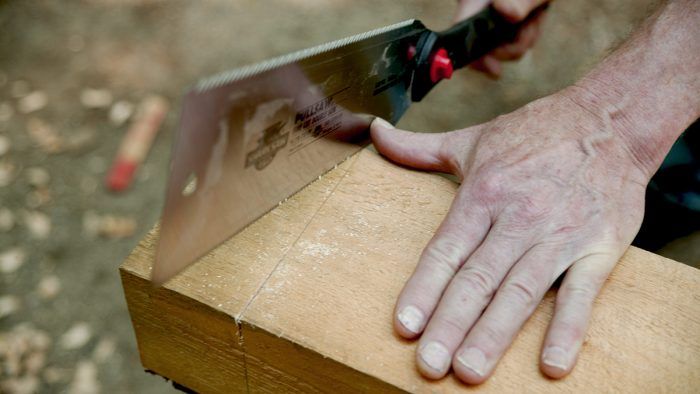
You probably won’t need a pull saw every day, but it’s a great tool to have when the need arises. Unlike Western-style saws, which cut on the push stroke, Japanese-style saws cut on the pull. Pulling on the blade takes advantage of steel’s higher tensile strength compared to its compressive strength. As a result, the extra thin blade on a Japanese saw cuts straighter and with greater accuracy than the blade on a Western saw.
You’ll find pull saws useful for cutting casing and base trim in place and for cutting small moldings. In short, they are great tools for using any time you need to make a precise, easily guided cut.
Japanese saws are available in a number of different styles. Perhaps the most useful for carpenters is the Ryoba. This type of saw has two sets of teeth: one set for crosscuts and one for rips. You can tell the difference between the two sets by looking at how light reflects along the teeth. If the light reflects the same on every tooth, it’s a rip blade. The teeth are usually bigger, too, but not always. If you see a bright reflection on every other tooth, it’s a crosscut blade. It used to be that Japanese-style saws were rare (and expensive), but now you can find them in just about every hardware store and home center.
Step by Step
Start the cut. Once you’ve marked the top and sides of the stock, gently push the saw against your thumb as you pull back on the handle. Your thumb should guide the blade so that the teeth are in the center of the line. Keep your thumb above the teeth to prevent getting cut.
Move your thumb away. Once the kerf is established, you can move both hands to the handle. Both thumbs should be lined up on top of the handle.
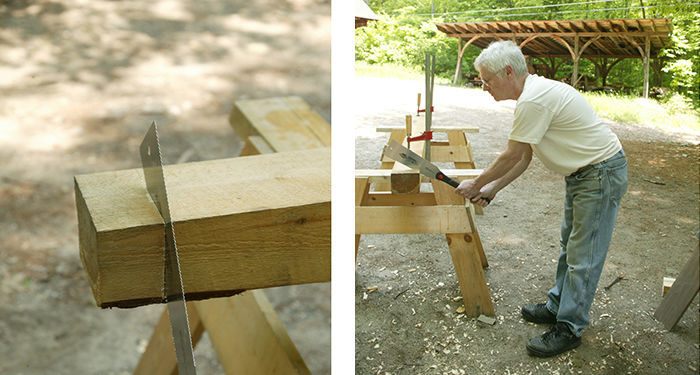
Take a stance. Position your body so that your dominant hand is directly behind the cutline and your feet are spread shoulder width apart. Hold the blade at a 45° angle, and cut with a steady, even rhythm.
Don’t cut a line you can’t see. Position your body so that you can see the cut progressing. You may need to crouch down to keep the blade from blocking your line of sight.
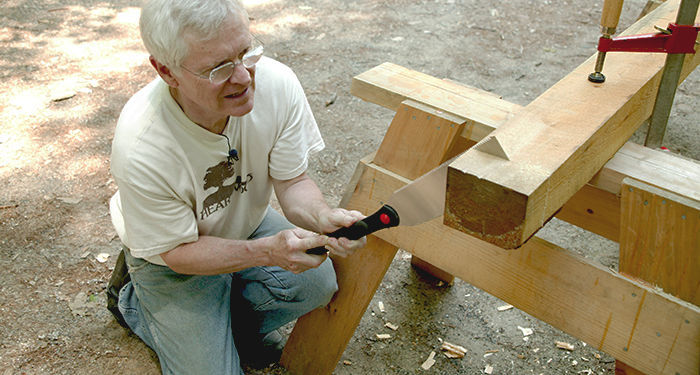
Change sides. Once you’ve cut through the first side, move your body to the other side of the stock. Use the existing kerf to line up the blade. Once again, cut with the blade at a 45° angle.
Level off the blade. To finish the center of the cut, let the weight of the saw do all the work. As you near the end of the cut, grab the offcut to prevent splitting along the grain.
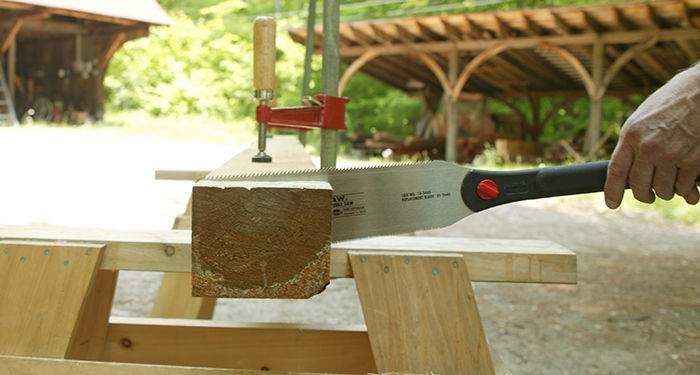
Video: How to Use a Japanese-Style Pull Saw
A good all-around pull saw
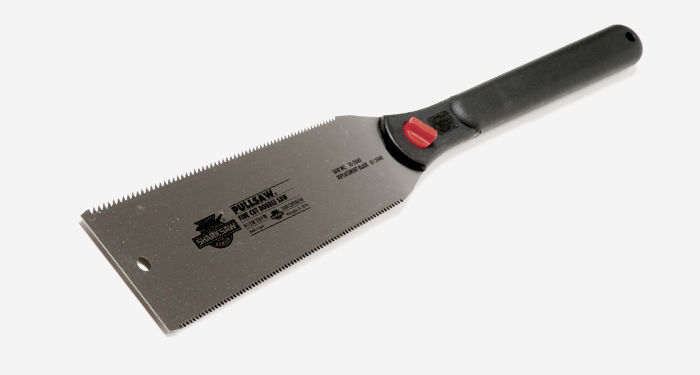
Top-quality Japanese-style pull saws for woodworking can cost hundreds of dollars, but a more-than-adequate saw for doing trimwork and other carpentry projects can be had for about $32.
Shark 10-2440 Fine Cut Saw 9-1⁄2-in. blade with 9-point (rip) and 17-point (crosscut) diamondshaped teeth and ABS handle
Photos: Charles Bickford and Dan Thorton
From Fine Homebuilding #224
