Q:
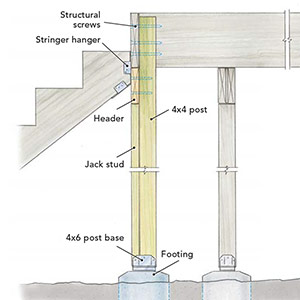
Shakey, swayey deck I built a deck off the back of my house that stands about 12 ft. above the ground. One end is attached to the house; the other end is secured to 16-ft. long 4×6 posts that extend above the deck to support the railing. The posts sit on top of concrete piers.
John Najarian, Haverhill, MA
A:
Jim Thompson, a structural engineer with McCormac Engineering Associates in Ellicott City, Maryland, replies: Any deck that’s attached to a house and that sits on posts on the far end is unstable when you apply a sideways force. People walking on the deck parallel to the house will cause a sideways force, and the deck will shake. Often the decking acts as enough of a diaphragm to stiffen the deck itself against these forces. Another thing that keeps most decks from moving too much is the length of their posts, which is usually 4 ft. or less. Your 16-ft. posts allow for more side-to-side movement. They also add a couple more complications.
Your posts sit on top of concrete piers. If the posts are on a typical post base, which is designed to keep them off the ground to prevent rot, then the posts are pivoting on their bases, increasing the amount of sway that you feel.
If your posts are anchored solidly, they will tend to bend. They bend because the ratio of their height and their dimension parallel to the house is too small to prevent bending; that is, the posts are too slender.
There are different remedies for each problem I have just described, but X bracing is the simplest in either case. It changes a rectangular section into two right triangles. Unlike rectangles, triangles are stable when you apply a force to the top angle.
X bracing can be done either vertically (between the posts) or horizontally (on the bottom of the joists). The least visible of the two is horizontal X bracing. Nail treated 2x lumber diagonally across the bottom of the joists, stiffening the deck so that it cannot change shape. When a lateral force is applied, one diagonal resists it, depending on which direction the force is applied. Fur down one member 1-1/2 in. so that the bracing laps at the intersection. If you stiffen the deck this way, all of the force that used to cause the deck to move will then be transferred to the house. The house framing should be checked to ensure that it can take this additional load.
Although bracing nailed under the deck is less visible than vertical bracing nailed to the posts, it’s not as effective. Vertical X bracing made from steel rods and a turnbuckle or steel cable would be less visible than lumber bracing in this case. X bracing applied vertically will solve both pivoting at the base and bending of the columns. Because this bracing transfers the force to the footings, they must be checked, too.