Q:
I plan to reshingle the low-slope roof (2-in-12 pitch) on my country cabin here in Canada. I would rather not have to remove the old shingles, but the roof has begun to leak. Can I just shingle over the existing roof, and do I need to use a special type of shingles?
Mauri Meere, Ottawa, None
A:
Former senior editor Roe A. Osborn replies: According to the Asphalt Roofing Manufacturers Association (301-348-2002), asphalt shingles can be applied to a roof with a pitch as shallow as 2-in-12. However, roofing over old shingles should be done only when the existing shingles and the roof underneath are in good shape. Also, roofing over old shingles adds a lot of extra weight to a roof, which can be especially problematic in high snow-load areas. So given your location and the fact that your roof is leaking, I recommend tearing off the old roofing and starting from scratch.
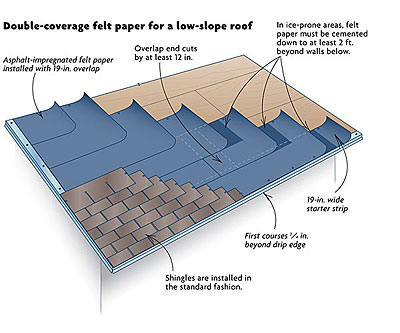
The ARMA’s Residential Manual for Asphalt Roofing recommends that asphalt shingles on low-slope roofs be applied over a nonperforated single layer of adhesive-backed bituminous membrane installed to the manufacturer’s specifications, or over a double layer of asphalt-impregnated felt paper. In your cold climate with the possible danger of ice dams, a bituminous membrane should suffice. But if you want to use felt paper, you need to take additional steps.
To install felt paper in a potential icedam situation, start with a 19-in. wide strip at the eaves extending over the drip edge by about 3/4 in. Use only enough nails to hold the paper in place until the shingles are applied. Cover this starter strip with asphalt lapping cement or asphalt plastic cement, and apply a full 3-ft. width of felt paper over the starter strip nailed only along the top edge.
Now snap a chalkline 19 in. down from the top edge, and spread cement over the entire upper half down to the line. Roll out the next course of paper with the lower edge following the line, and again nail it just along the top edge. That course is then overlapping the course below by 19 in., giving you double coverage. Again, snap a chalkline 19 in. down from the top edge, and repeat the process until you have cemented the paper down at least 2 ft. in from the plane of the house walls below.
From this point, the felt paper can be installed without cement to the top of the roof plane maintaining the 19-in. overlap. If you have to end a felt-paper strip in the middle of a course, overlap the next piece at least 12 in., and make sure there is no other end lap within 6 ft. The shingles are then applied according to the manufacturer’s directions. Be sure to use self-adhering shingles if you live in a high-wind area.