When we build a porch or deck, we prefer to lay out the railing balusters with equal spaces between them. Problem is, the distance between a pair of posts can vary — say 92 in. to 94 in. It’s not a big difference, but it forces us to calculate different on-center spacings for each set of balusters so that we don’t end up with a baluster too close to one of the posts. Calculating and marking these separate layouts is a pain.
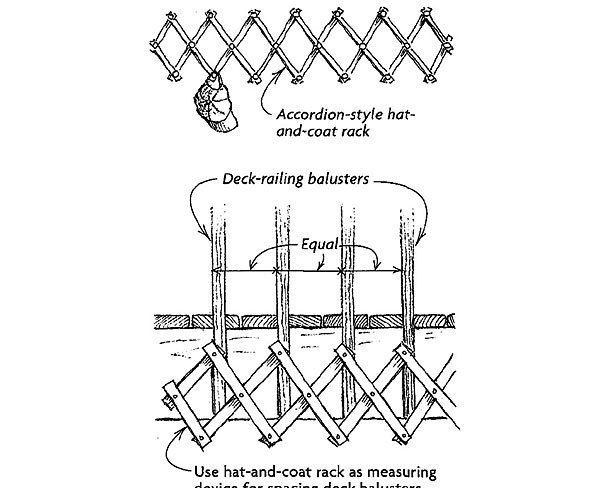
Out of the blue, my brother, Bruce, had an idea that seemed crazy to me, but makes sense and really works. We bought a couple of large, accordion-style expanding hat-and-coat racks that work like old-fashioned toddler gates. As you stretch out the rack, the points where they hinge at the top and bottom space out equally. By connecting a couple of racks together, we were able to make a baluster-layout device that will work for spacing balusters between posts up to 9 ft. apart.
To use the device, orient the rack with one end against the beginning post and expand the rack until its hinge points roughly equal the baluster spacing. The end of the rack will likely have to extend beyond the ending post. Orient the closest hinge point with that post. Now make the baluster marks on the deck and adjust them for the thickness of the baluster stock you’re using.
Mike Guertin, East Greenwich, RI