The Secret Life of Masking Tape
Making crisp lines on painting projects is only one of the many uses this versatile product is good for.
People who use masking tape just to keep paint from straying onto the wrong surface are missing out on some of its most useful characteristics. Masking tape is light in color, cheap, and it can be written on easily. These attributes make it ideal for various marking and layout applications. Here are some examples of how I use the stuff. By the way, I use the 2-in. wide variety, and I don’t worry about what brand it is.
Make easy-to-see marks on anything: Pencil marks on dark wood are tough to see, so I stick a piece of masking tape to the wood and make my mark on the tape. I do the same on glass or ceramic surfaces that don’t take a pencil mark well. And if I need to make a reference mark on a Stringline, I make a masking-tape flag on the string and make my mark on it.
Temporary chalkline: You can make a removable chalkline on virtually anything — even carpet — by snapping the line on a strip of masking tape. If you’ve snapped a couple of misplaced lines on a surface, clear the picture by taping over them and beginning anew on a fresh run of masking tape.
Layout for plumbing and wiring: When remodeling, I often tear out everything down to the bare studs. Then, to show clearly the placement of new electrical and plumbing components, I stretch a horizontal length of tape over the studs and map my locations on it.
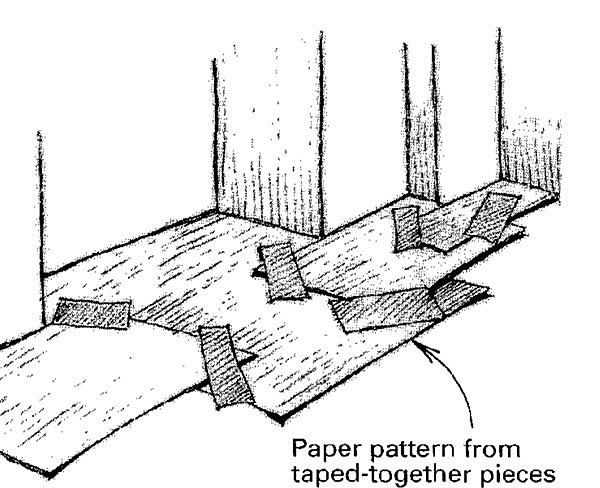
Quick and accurate templates: I also make templates using masking tape and heavy paper. (I use manila folders because they’re cheap, and they work well.) For example, if I need to cut out a complex sheet of 1/4-in. underlayment for a bathroom floor, I’ll make a pattern of the projections and indentations by taping pieces of paper together, as shown in the drawing above.
Simple labels: Masking tape helps me organize. I’m always using it to label loose electrical wires. To keep small, yet important parts from getting lost, I wrap them in tape, label them on the outside and stick them in a safe place.
Light-duty clamping: Masking tape can be used as a clamp where nothing else will work. For example, to fix splits in delicate wood trim, I apply the glue and then wrap the trim with a piece of masking tape until the glue sets up. And when I’m tiling walls, I can keep a row of tile from slipping before the mastic sets with a strip of tape affixed to an anchorage above the tile.
Herrick Kimball, Moravia, NY