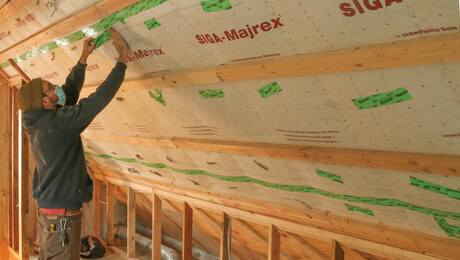
I did a video two weeks ago about Advanced Framing and it’s really taken off with alot of views right out of the gate. I didn’t realize that framing would be so interesting! Anyhow, I though I’d follow up with a video of how we insulated that Advanced Framed house. As you’ll see in the video there are three types of insulation going on this house.
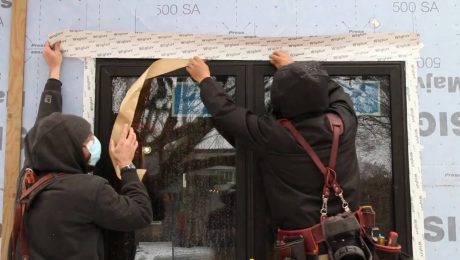
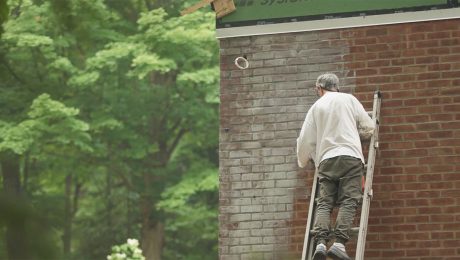
#1 Rigid Foam “Outsulation” – The entire outside of the house has a blanket of R-5 insulation on top of the Tyvek Drainwrap. We used 3/4″ R-Max with a foil face to the rain screen air cavity behind the siding.
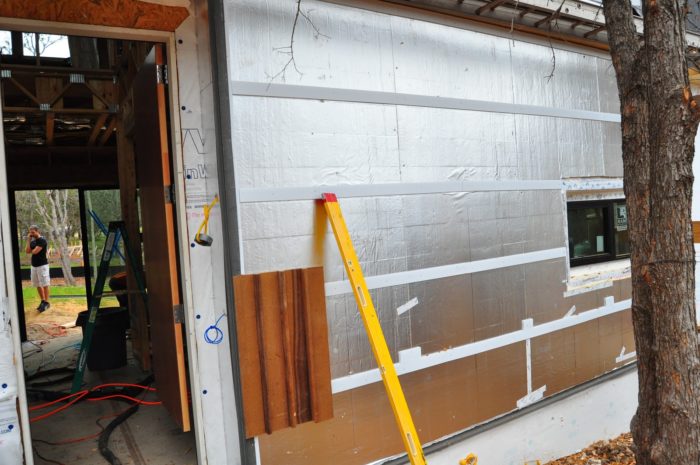
I’ve become a huge believer in exterior rigid foam over the last few years and I can see going to greater depths of foam in the near future. No matter the type of framing (traditional or advanced, 2×4 or 2×6) your house will GREATLY benefit by using a layer of rigid foam on the outside. Be sure to use a draining housewrap behind the foam as I don’t think face sealing the foam is a great way to weatherize a house. I think there is no better housewrap on the market today than Tyvek Drainwrap or it’s tougher cousin CommercialWrap D. See my video where I tested the water shedding capability of Tyvek Drainwrap sandwiched with 1″ rigid foam.
#2 Owens Corning Energy Complete. For standard 2×6 stud bays I really like this two part system from Owens Corning. I did a few videos on this last year. It’s basically a standard Blown In Blanket fiberglass system with a special air sealing step. The air sealing is what truly sets this apart.
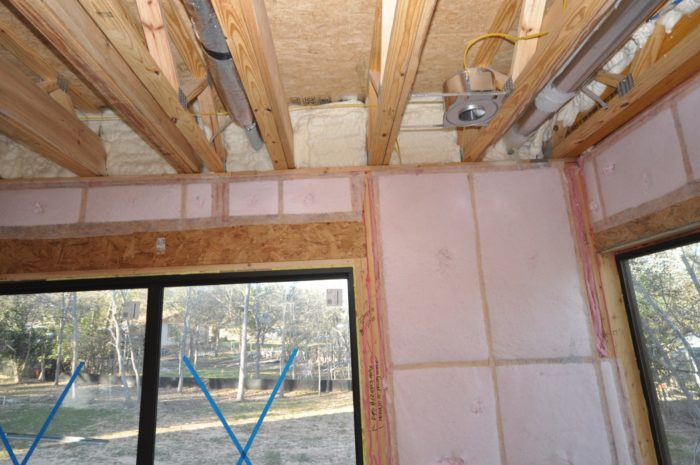
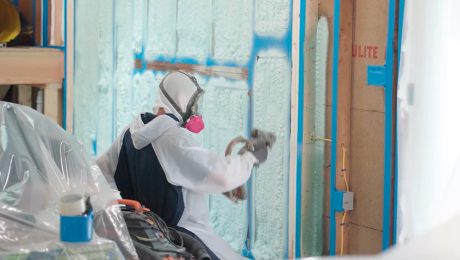
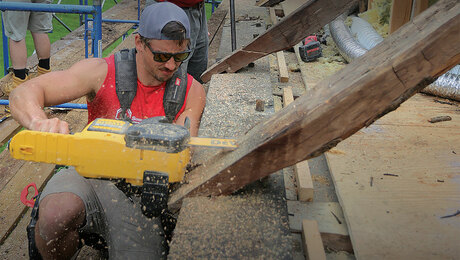
#3 Open Cell Spray Foam. Yes that’s right. Both fiberglass and Spray Foam in the same house! I’m not talking about canned foam though I do use alot of those too. There is no better air sealer than spray foam and in many applications there is no better way to insulate. You’ll see in this video we used the spray foam in the garage both walls and ceiling, the roof, and in the truss bands around the house.
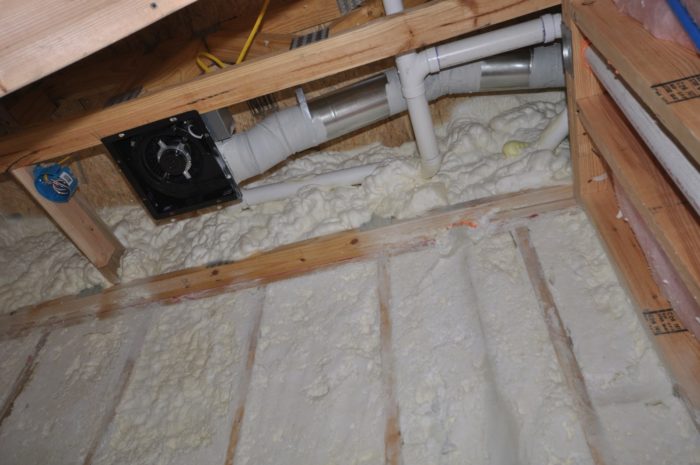
Here’s a shot of the powder bath in the foreground and the garage is behind that foam. I believe there is no better way to air seal a garage/house connection than spray foam. Notice my Panasonic WhisperValue exhaust fan (I like a slightly louder fan in the powder bath) with that excellent rigid duct install with mastic on the seams!
Happy New Years everyone!
– Matt Risinger












View Comments
What is the reason for doing the walls with blow in instead of spray foam if you already had a spray foam crew on site? Is there that much of a cost savings on the blown in vs open cell spray?
@Hicks273: Cost was the main driver on this. With 2x6 advanced framed walls it's less expensive to get a bigger R-value with BIBS than with Open Cell foam. But, as you saw in the video I really believe there is no substitute for foam in a few key locations. That garage ceiling with living space above is nearly impossible to insulate well without using foam. The air sealing of the foam is also super important in a house with an attached garage. The common walls really need foam to seal to the highest possible level of air tightness. Thanks for commenting, Matt
Foam is a great insulator but extremely expensive. I have been a builder for forty years and I find that it is too expensive for my own house. The savings have to be weighed out with time factors including how long are you going to live. I am building my last house for myself and at 65 years old I would never get my money back. Plus I would have to borrow money to afford it and no one will loan money to someone that age with low income.
Here in CA framing with the earthquake codes makes for more heat loss because of the extra studs required. Foam sheets over the surface would help but the cost of doing that comes in also. It does seem like the foam surface would not be a good system with stucco or cement board siding. Which is all we can use here in the CA rural areas due to fire codes.
Solar electric has the same problem with payback time, and with my rural mountain setting coupled with solar costs I would never get my money back. Trees which limit my sun exposure are good for reducing solar radiation on my house but they also reduce the ability of the solar panel effectiveness. I do not know how it works in other areas but here solar electric can only reduce you bill to zero but you can never make money on it, any extra electricity you make is a gift to the power company.
The bottom line is not every idea will work in every situation or location, especially with the codes and age factor of the owner.
While I understand the comments above on foam and costs, I see very few in the construction industry who look at life cycle costs, initial cost plus savings in operating cost, on a tradeoff basis. It is estimated that more than 80% of all existing buildings are energy inefficient. Those buildings will be there 30, 50, and maybe 100 years. Obviously initial cost pales compared to operating cost over that period of time. Habitat for Humanity has now found it is better to build efficiently based on comparative data. With 2 x 6 framing the R 13 or R 14 wall is a poorly insulated wall for most areas of the country.
The 100 Home Challenge is illustrating the value of air sealing and superior insulation coupled with solar. A blower door test dramatically illustrates air leakage coupled with a thermal camera. A friend of mine in Chambersburg has achieved near net zero for his house using some of the ideas shown here. I have achieved close to that on a design basis using passive solar design techniques, SIP walls to achieve an R 32 wall, and solar. I find most superior construction for energy efficiency is driven by the home owner insisting on superior energy efficiency, not by the home building industry. At the very least I think the industry should offer the owner options on energy efficiency decisions rather than just building to code.
Lindy62
In our moist winter climate, your wrapping the home with a rigid foam product would be disastrous. We have to make sure our entire air barrier and insulation system lets water vapor breathe outward. In western North Carolina we have found open cell spray foam very competitive. For us the easiest, most cost effective solution is open cell sprayfoam.
But we use another technique that is just as effective and usually adds no cost, designing the house and roof overhang to keep summer sun off the glass, but allow winter sun to heat up the glass.
We also ass rigid foundation insulation to the exterior of the basement walls.
These three techniques bring heating and cooling costs way down, and for very little cost difference.
https://www.facebook.com/MountainHousePlans
Pardon the typo.
MountainHousePlans writes: In our moist winter climate, your wrapping the home with a rigid foam product would be disastrous. We have to make sure our entire air barrier and insulation system lets water vapor breathe outward. In western North Carolina we have found open cell spray foam very competitive. For us the easiest, most cost effective solution is open cell sprayfoam.
But we use another technique that is just as effective and usually adds no cost, designing the house and roof overhang to keep summer sun off the glass, but allow winter sun to heat up the glass.
We also add rigid fiberglass foundation insulation to the exterior of the basement walls.
These three techniques bring heating and cooling costs way down, and for very little cost difference.
https://www.facebook.com/MountainHousePlans
THE ADVANTAGE OF FOAM IS IN ITS ABILITY TO SEAL WALLS TO STOP AIR FLOW, IF USED IN CONJUNCTION WITH LESS EXPENSIVE BATT INSULATION, IN A DOUBLE FRAMED WALL WITH A VENTED AIR GAP MOISTURE BUILD UP AND HEAT TRANSFER CAN BE REGULATED. IT HAS WORKED WELL FOR ME IN HIGH HUMIDITY, AND TEMPS OF SOUTH TEXAS,
Hello Matt. My enthusiasm for Spray foam evaporated when the house across the street burnt down a month ago, taking its neighbour's - my friends - down with it. The foam contractor was working all day, the fire broke out that night. The cause has been determined to be the release of heat by the curing foam. I have since looked into the matter: indeed, the curing of foam is an exothermic reaction - it produces heat when it cures, in the same way that linseed oil does. If it is not applied very carefully in small increments it can self-ignite, hours after it has been applied. It is also extremely flammable so once it is ignited it spreads, especially when the walls are all open. The chemicals produce a very stubborn flame: it took 6 hours to get the blaze under control.
Who spends the day looking over the shoulder of the foam applicator? Or spends the night on guard at the job site with a fire extinguisher in hand?
It is now a fight to the death between the insurance companies.
This has scared me too much to spec foam.
It is worth looking into.
-Daniel, Toronto, Canada
@Daniel G: Super Tragic story, I'm so sorry to hear about your friends house. Yes, foam is not without danger. This is a good reminder to use a trained & certified installer. I get bid solicitations all the time from new/random foam installers and I'm not fooled by a low bid. I only solicit foam bids from companies I trust, have been in business for a long time, and are certified installers. Look for two certifications. #1 The manufacturer of the foam they're spraying #2 http://www.spraypolyurethane.org These guys are an industry group that trains & certifies.
I believe the rewards are worth the risk but that's a choice every client & builder needs to make an informed decision about. The riskiest thing we do every day is drive a car, when we buy our cars we research the model, check the crash ratings and eventually most of us decide the reward of driving is worth the risk.
Thanks for the reminder on this important topic. Best, Matt Risinger
Thanks for this post.you might be interested in checking out fine luxury homes by Brejnik Fine Homes (www.brejnik.ca). They build fine luxury houses. Brejnik team consists of qualified and trusted: Architects, Interior Designers, Appraisers / Lenders, Trades & Suppliers, Geo-technical engineers, Structural Engineers, Arborists, Landscape Architects, Pool & Water Feature Specialists.