Q:
How do I repair stress cracks in drywall above door jambs? The cracks go straight up as well as off at a 45° angle.
Wayne Paley, via email, None
A:
Myron R. Ferguson ( www.thatdrywallguy.com ), author of Drywall (The Taunton Press, 2002), replies: I try to avoid locating seams between drywall panels above door and window openings because this invites cracking as the building settles. When seams must land above an opening, keep the seam at least 7 in. away from the edge.
I also like to use drywall adhesive when attaching drywall to help strengthen the seam. If the crack is at an angle, then it is not a seam cracking. It is the drywall itself, meaning the house has had a lot of settling.
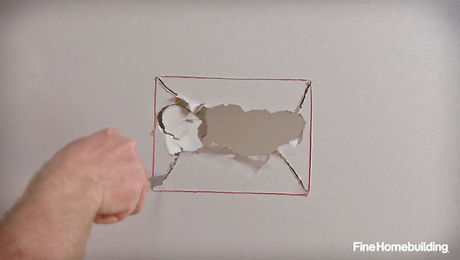
The crack most likely extends all the way through the drywall. You can make a stronger repair if you widen the drywall crack into a V-shape, then fill the hole with some heavyweight joint compound. Let the joint compound dry before adding the tape. I like to use the strongest tape that’s available in combination with the strongest compound, which is usually a setting compound.
Most fiberglass-mesh tapes are not as strong as paper tape, but a new type of mesh tape is thinner than paper tape and also stronger. It is called Perfect Finish, from FibaTape (www.fibatape.com). Of course, the thinner tape also produces less of a bump, making the repair less conspicuous.
Feather the repair wide, then lightly sand. I have been using a new type of compound from USG (www.usg.com), called Plus 3 with Dust Control. This product creates less airborne dust than regular compound, so there is less mess to clean up.