previous
  • 15 Coffered Ceiling Design Ideas and Tips
    15 Coffered Ceiling Design Ideas and Tips
  • Meet the Fine Homebuilding Project House!
    Meet the Fine Homebuilding Project House!
  • Roofing articles, videos, tools, and materials
    Roofing articles, videos, tools, and materials
  • 12 Remodeling Secrets Revealed
    12 Remodeling Secrets Revealed
  • 7 Solutions for Kitchen Layout and Design
    7 Solutions for Kitchen Layout and Design
  • 2012 HOUSES Awards
    2012 HOUSES Awards
  • 10 Basement-Remodeling Tips and Techniques
    10 Basement-Remodeling Tips and Techniques
  • Energy-Smart Details
    Energy-Smart Details
  • The Inspector Game: Decking Dos and Don'ts
    The Inspector Game: Decking Dos and Don'ts
  • How it Works
    How it Works
  • 7 Small Bathroom Floorplan Layouts
    7 Small Bathroom Floorplan Layouts
  • Fine Homebuilding: The Digital Issues
    Fine Homebuilding: The Digital Issues
  • Buyer's Guide to Decking
    Buyer's Guide to Decking
  • 13 Door Design and Installation Tips
    13 Door Design and Installation Tips
  • Deck Design & Construction Showcase
    Deck Design & Construction Showcase
  • Painting Ideas, Tips, and Techniques for a Professional Finish
    Painting Ideas, Tips, and Techniques for a Professional Finish
  • Complete Kitchen and Bath Guide
    Complete Kitchen and Bath Guide
  • 9 Design Ideas & Tips for Concrete Countertops
    9 Design Ideas & Tips for Concrete Countertops
  • Guide to Paperless Drywall
    Guide to Paperless Drywall
  • Outdoor Kitchen Design Inspiration
    Outdoor Kitchen Design Inspiration
next
Pin It

Paper-tape mud dispenser

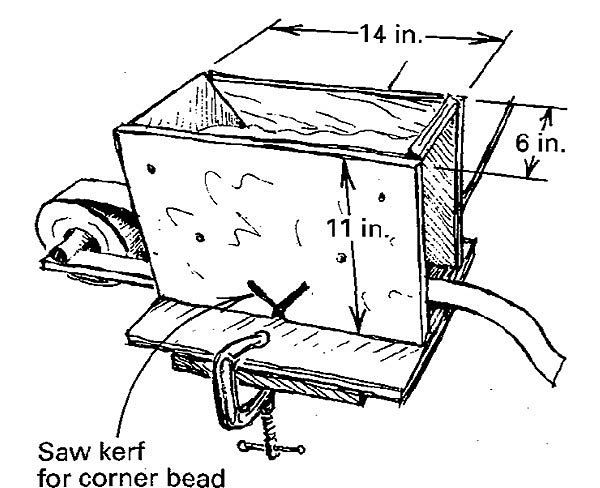
Whenever I use paper tape to cover drywall seams, I make it easy on myself by using tape that has been precoated with joint compound. As shown in the first drawing, I run the tape through a wooden hopper containing joint compound (I thin the mud to the consistency of thick mushroom soup). The hopper, which I varnished to make it easy to clean after a taping session, is mounted to a square of 3/4-in. plywood. I clamp the plywood to whatever convenient work surface is at hand.

The tape spool is mounted on the infeed side of the hopper. The spool spins on a dowel that is held in place by a pipe hanger. On the outfeed side of the hopper, I affixed a length of hacksaw blade for cutting the tape.

When I'm using this rig for paper tape, I install the roll and slide the paper through until it protrudes on the outfeed side. Then I fill the hopper about half-full of joint compound. I pull the tape slowly through the hopper, and if the mud is the right consistency, a layer about 1/8-in. thick sticks to the back of the paper.

If the job calls for outside corner beads -- the type that are part metal and part paper -- I remove the roll of paper tape, which allows me to run the comer beads through the V-shaped kerfs on the sides of the hopper.


Keith R. Sheppard, Monarch, Alta., ca
From Fine Homebuilding 96, pp. 28 July 1, 1995