previous
  • Fine Homebuilding: The Digital Issues
    Fine Homebuilding: The Digital Issues
  • Your Guide to Energy Smart Homes
    Your Guide to Energy Smart Homes
  • 10 Basement-Remodeling Tips and Techniques
    10 Basement-Remodeling Tips and Techniques
  • Top 10 Videos of 2011
    Top 10 Videos of 2011
  • How To Make a Reciprocating-Saw Blade Guide Block
    How To Make a Reciprocating-Saw Blade Guide Block
  • Protecting a SIPS Roof from Decay
    Protecting a SIPS Roof from Decay
  • 7 Small Bathroom Layouts
    7 Small Bathroom Layouts
  • How to Avoid Complicated Fractions
    How to Avoid Complicated Fractions
  • VIDEO: Stop Paint from Bleeding
    VIDEO: Stop Paint from Bleeding
  • Wanted: Plumber for a Bathroom Remodel
    Wanted: Plumber for a Bathroom Remodel
  • The Inspector Game: Goofs on a Roof
    The Inspector Game: Goofs on a Roof
  • How to Figure Out Concrete Volume with Sketchup
    How to Figure Out Concrete Volume with Sketchup
  • Patrick's Barn: A Perfect Place for a Party
    Patrick's Barn: A Perfect Place for a Party
  • Replacing a Roof : Installing a Ridge Vent
    Replacing a Roof : Installing a Ridge Vent
  • Seven Steps to Choosing the Perfect Circular Saw
    Seven Steps to Choosing the Perfect Circular Saw
next

Big box lends a hand

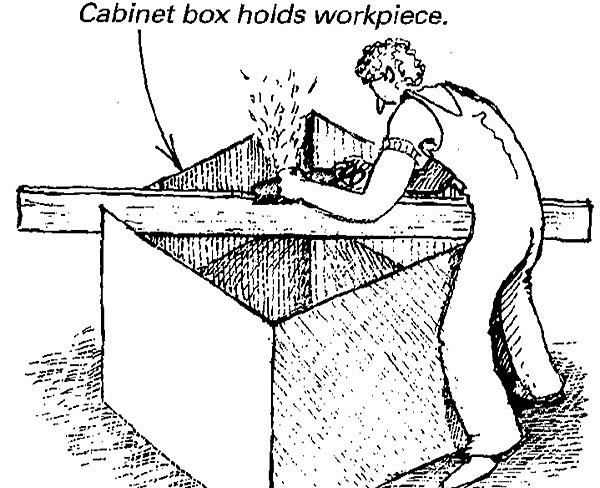
Every house seems to have a couple of pieces of trim that require planing on their narrow edge. My hand-held power planer does quick and neat work of these tasks, but holding the trim while it's being planed can be a problem. I can set up a workbench to do the job, but anyone who's done interior trim work for production builders knows that time is of the essence. Any tool setups that I can safely avoid are money in my pocket.

Because I'm the guy who follows the cabinetmaker, it turned out that the answer to my trim-holding problem was right in front of me. As shown in the drawing, an empty basecabinet box gets it done. First, I fold the top flaps of the box inward. Then I cut slits in opposite corners, two-thirds the depth of the workpiece. Friction holds the work in place, and the basecabinet box is wide enough to be stable and tall enough to be a comfortable work height.


A B. Zeller, II, Charlotte, NC
From Fine Homebuilding 97, pp. 30 September 1, 1995