previous
  • How it Works
    How it Works
  • Guide to Paperless Drywall
    Guide to Paperless Drywall
  • Complete Kitchen and Bath Guide
    Complete Kitchen and Bath Guide
  • 7 Solutions for Kitchen Layout and Design
    7 Solutions for Kitchen Layout and Design
  • The Inspector Game: Decking Dos and Don'ts
    The Inspector Game: Decking Dos and Don'ts
  • 10 Basement-Remodeling Tips and Techniques
    10 Basement-Remodeling Tips and Techniques
  • Meet the Fine Homebuilding Project House!
    Meet the Fine Homebuilding Project House!
  • Fine Homebuilding: The Digital Issues
    Fine Homebuilding: The Digital Issues
  • Painting Ideas, Tips, and Techniques for a Professional Finish
    Painting Ideas, Tips, and Techniques for a Professional Finish
  • Buyer's Guide to Decking
    Buyer's Guide to Decking
  • 13 Door Design and Installation Tips
    13 Door Design and Installation Tips
  • 12 Remodeling Secrets Revealed
    12 Remodeling Secrets Revealed
  • Deck Design & Construction Showcase
    Deck Design & Construction Showcase
  • 2012 HOUSES Awards
    2012 HOUSES Awards
  • Roofing articles, videos, tools, and materials
    Roofing articles, videos, tools, and materials
  • 15 Coffered Ceiling Design Ideas and Tips
    15 Coffered Ceiling Design Ideas and Tips
  • 9 Design Ideas & Tips for Concrete Countertops
    9 Design Ideas & Tips for Concrete Countertops
  • Outdoor Kitchen Design Inspiration
    Outdoor Kitchen Design Inspiration
  • Energy-Smart Details
    Energy-Smart Details
  • 7 Small Bathroom Floorplan Layouts
    7 Small Bathroom Floorplan Layouts
next

Three bathroom refinements

Clever ways to hide plumbing, trash containers and toilet paper

Hidden trash can

My vanity cabinet intersects the end wall at 45°. I wanted to use the resulting space effectively and decided to hide a small trash can there. The available space was just the right fit for an empty 1-gal. drywall-mud container. With the bottom cut out, it acts as a support ring for a trash bag secured with a rubber band. I mounted a shelf inside the cabinet door and cut a hole in it for the container.

The cabinet door swings out from the bottom, which prevents the shelf from interfering with the door frame. The vanity doors all look the same from the outside, so a tug on this particular door’s handle results in a slight surprise. A catch at the end of a thin oak strip lets the door fall open just enough to expose the trash can. Pressing this springy strip releases the catch, allowing the door to open wider for access to the cleaning supplies stored in the cabinet. A small brass plaque on the door identifies the trash location for guests.
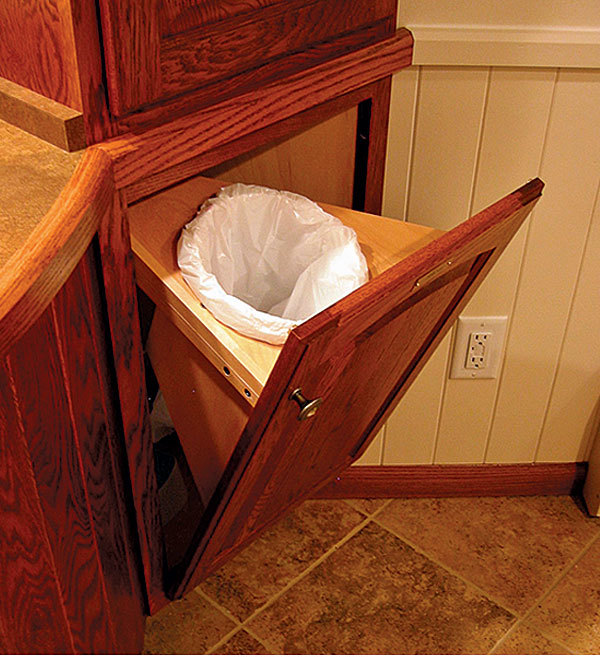
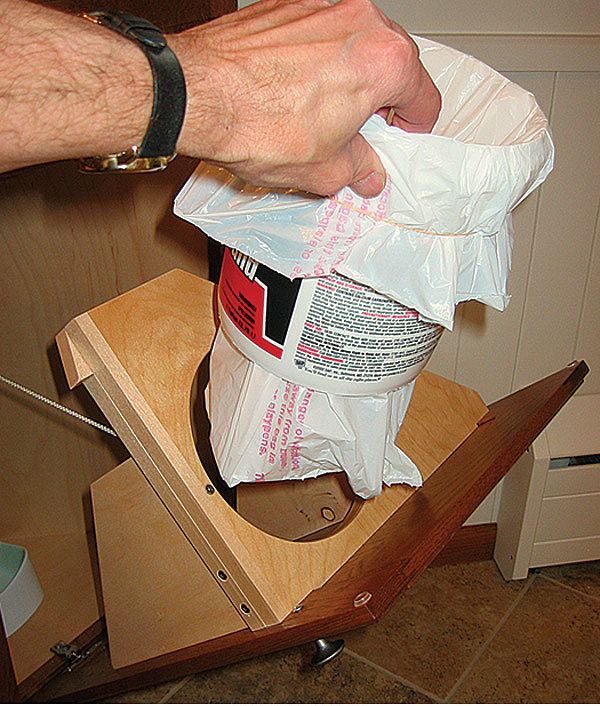
Hidden in plain sight. A recycled drywall-mud bucket holds a trash bag secured with a rubber band. Click to enlarge image Hidden in plain sight. A recycled drywall-mud bucket holds a trash bag secured with a rubber band.
A catch lets the door fall open just enough to expose the trash can. It can be removed easily for emptying. Click to enlarge image A catch lets the door fall open just enough to expose the trash can. It can be removed easily for emptying.

Wainscot plumbing access door

If repairs are needed, access to the tub and shower valve hidden in the wall cavity is provided via a removable door camouflaged in the wainscot. I sized the door so that its vertical edges coincide with V-grooves in the tongue-and-groove wainscot. When I glued up the door, I applied a couple of reinforcing ribs behind it. The tongue edge of the door slips into the groove of the adjacent fixed wall panel. I machined off the inside half of the groove on the other edge so that it can lap over the mating wall-panel tongue.

The top and bottom of the door are concealed by the baseboard and by a rabbet underneath the chair rail. When the baseboard’s trim-head screws are removed, the access door can be slipped down below the rabbet and swung out to expose the plumbing.
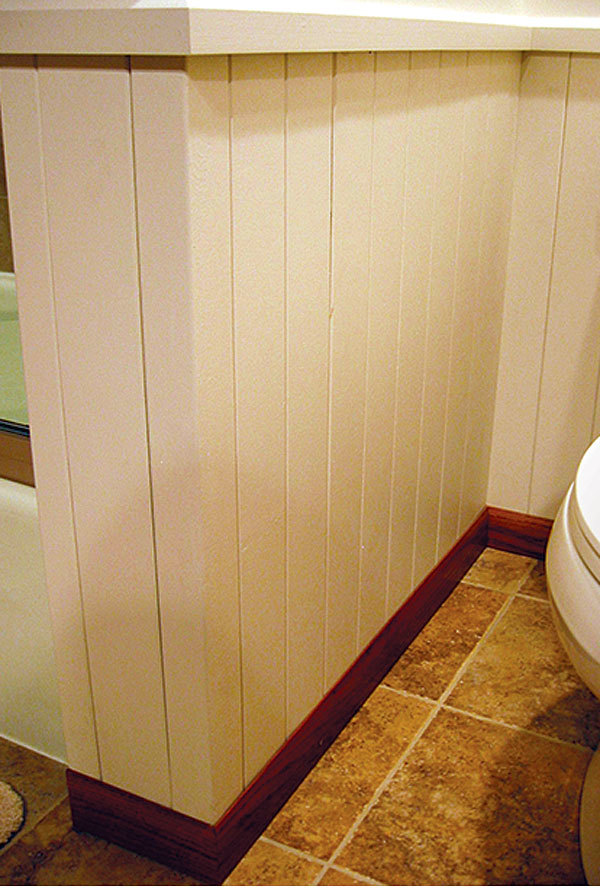
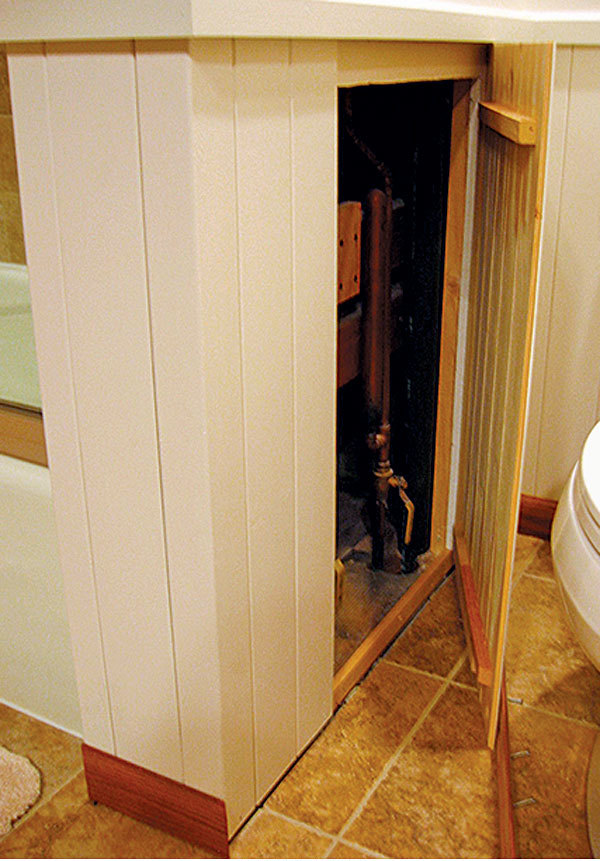
Now you see it, now you don’t. When closed, the door blends right in. Click to enlarge image Now you see it, now you don’t. When closed, the door blends right in.
The plumbing access makes repairs painless Click to enlarge image The plumbing access makes repairs painless

Recessed toilet-paper dispenser

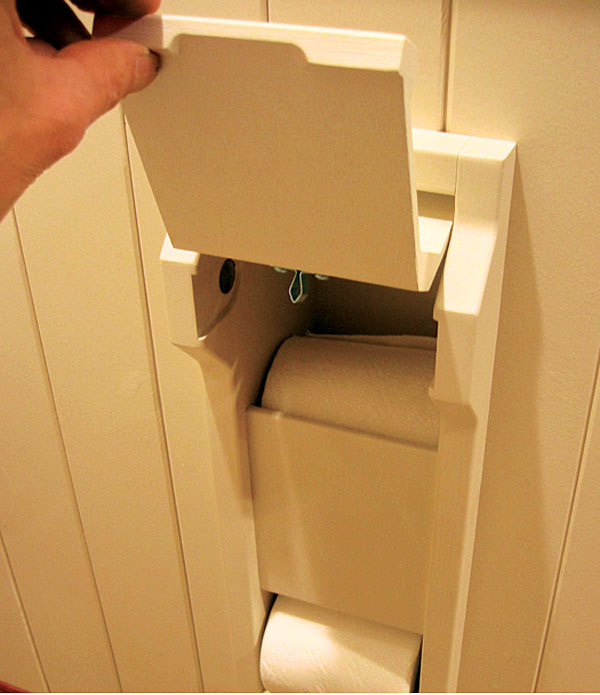
My toilet-paper dispenser is handy for many reasons, not least of which is storage of extra rolls. Recessed into the wall cavity, the integrated chamber holds three rolls; when the bottom one is removed, another falls into place.

In the dispenser, a wooden spindle slips into grooves cut in the frame. Magnets epoxied into countersunk holes in the dispenser frame attract flathead wood screws in the spindle ends. A tug on the spindle releases it to remove and replace an empty roll. With the spindle removed, the hinged dispenser lid can be lifted to load additional rolls.
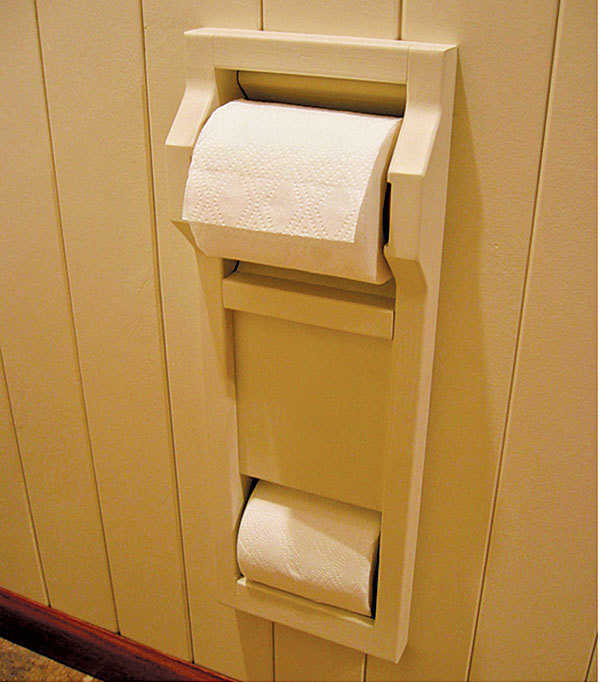
Functional and handsome. This clever built-in dispenser does double duty. Click to enlarge image Functional and handsome. This clever built-in dispenser does double duty.
Never run out. Flipping up the dispenser lid exposes the roll-storage chamber. Click to enlarge image Never run out. Flipping up the dispenser lid exposes the roll-storage chamber.
Photos by: Dwayne Intveld

From Fine Homebuilding199 (Kitchens & Baths) , pp. 18 October 15, 2008