previous
  • Protecting a SIPS Roof from Decay
    Protecting a SIPS Roof from Decay
  • Fine Homebuilding: The Digital Issues
    Fine Homebuilding: The Digital Issues
  • 7 Small Bathroom Layouts
    7 Small Bathroom Layouts
  • How to Avoid Complicated Fractions
    How to Avoid Complicated Fractions
  • Top 10 Videos of 2011
    Top 10 Videos of 2011
  • The Inspector Game: Goofs on a Roof
    The Inspector Game: Goofs on a Roof
  • Seven Steps to Choosing the Perfect Circular Saw
    Seven Steps to Choosing the Perfect Circular Saw
  • Replacing a Roof : Installing a Ridge Vent
    Replacing a Roof : Installing a Ridge Vent
  • Wanted: Plumber for a Bathroom Remodel
    Wanted: Plumber for a Bathroom Remodel
  • How To Make a Reciprocating-Saw Blade Guide Block
    How To Make a Reciprocating-Saw Blade Guide Block
  • How to Figure Out Concrete Volume with Sketchup
    How to Figure Out Concrete Volume with Sketchup
  • VIDEO: Stop Paint from Bleeding
    VIDEO: Stop Paint from Bleeding
  • 10 Basement-Remodeling Tips and Techniques
    10 Basement-Remodeling Tips and Techniques
  • Your Guide to Energy Smart Homes
    Your Guide to Energy Smart Homes
  • Patrick's Barn: A Perfect Place for a Party
    Patrick's Barn: A Perfect Place for a Party
next

Site-cast sash weight

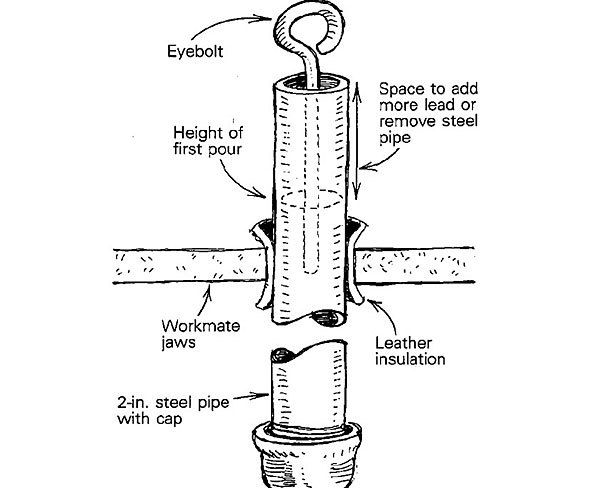
I had to restore an old double-hung window that measured 4 ft. by 6 ft., but only one of the two sash weights remained in its pocket. To make the window operational again, I'd have to come up with another sash weight. Not having a salvage yard nearby, I resolved to make my own weight.

I had a 2-ft. length of 2-in. pipe on hand. As shown in the drawing, I capped one end of it and clamped it upright in the jaws of my Workmate. After figuring the difference in weight between the pipe and the original sash weight, I got out some old lead pipe to make up the difference. Wearing gloves, goggles and a respirator, I melted the lead in a plumber's crucible and carefully poured it into my steel pipe. I did this outdoors, and protected the area under the pipe with some firebrick to prevent any spills from causing a fire. Once the lead was within a few inches from the top of the pipe, 1 inserted a 6-in. eyebolt and held it steady until the molten lead cooled enough to set up. The two weights ended up weighing virtually the same amount, but if I'd needed to adjust the new one, I could have added a little more lead to the space at the top of the pipe, or removed some of the pipe to trim it down a bit.


Dave Marlow, Warrenton, VA
From Fine Homebuilding 68, pp. 30 July 1, 1991