More Painting Tips
Painter Frank Sinicrope answers common questions about interior finishes.
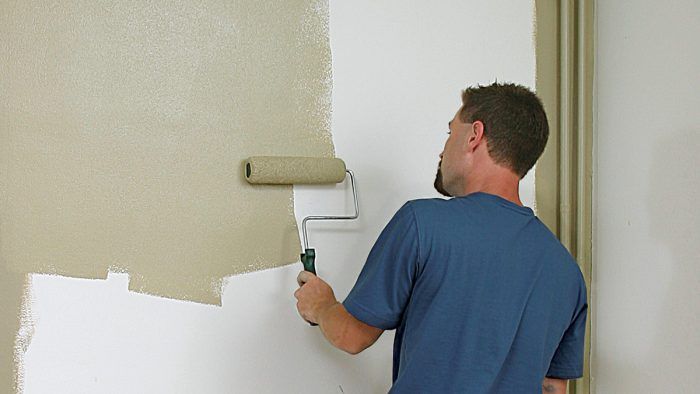
In the October/November 2004 issue of Fine Homebuilding, Connecticut painting contractor Frank Sinicrope shares some of his trade secrets. Here are a few more, along with answers to your most commonly asked painting questions. Read Frank’s article, Painting Solutions from Fine Homebuilding #166, pp. 84-88 to learn more about Frank’s techniques.
How can I make wall painting go faster?
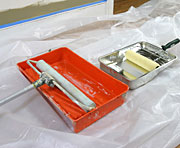
Instead of the normal roller, which is 9 in.wide, pro painters often use an 18-in.-wide setup that covers lots of territory fast. Available in most paint stores, a roller, pad, and pan cost about $40.
 |
 |
What is the best way to paint a window?
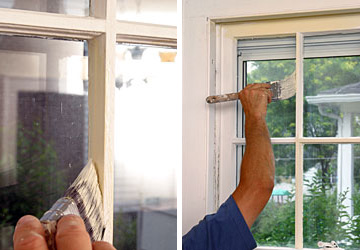
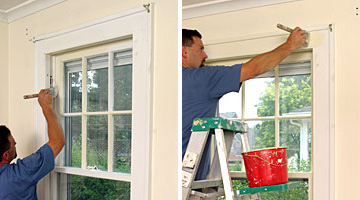
I begin by painting the mullions of the window first, and then move to the face of the window. With a 2-1/2-in. sash brush, I angle the brush’s tip into the mullion’s edge and draw the paint along the mullion with one smooth stroke. (If you’re unsure of your technique or don’t want to bother, you can mask the glass with blue tape or scrape the glass once paint has dried.) Don’t apply too much paint to the window frame; also open and close the window a number of times during the drying period so that it doesn’t dry shut. If the window is painted shut, carefully run a razor blade between the window frame and casing to break the seal.
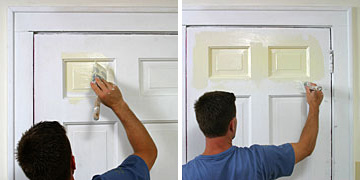
What is the best way to paint a paneled door and not get lap marks?
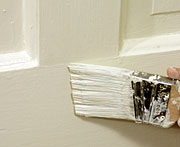
Panel doors should first be primed with a high quality primer to eliminate any bleed-through stains. Multiple finish coats (usually two) may be necessary to get good coverage. Ask the paint supplier to tint the color of the primer as close as possible to the color of the final coat paint. Again, the secret to stopping the lap marks is to use a smooth last stroke with little paint and light pressure.
1. Start by painting at the top of the door, panels first, then rails, then stiles. Here, less paint is better to prevent drips; two coats lightly applied are better than than one heavy coat that drips.
2. Be sure to keep the paint’s leading edge wet to prevent brush marks. A final light stroke across the panel faces and along the intersections of rails and styles will obliterate sags and brushmarks.
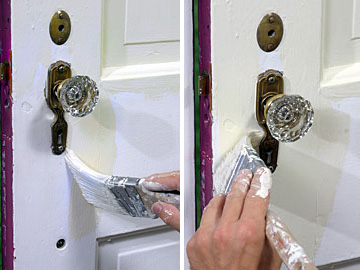
3. When you reach the door knob, use even less paint to get a seamless stroke pattern. The trick is to brush around the knob with continuous strokes and avoid stops. Masking or removing the hardware is also an option.
4. Be sure to check for drips, particularly in recessed areas and along the door edges. As long as the paint is still fairly wet, drips can be erased with a light brush stroke.
Frank Sinicrope owns and operates American Capitol Painting in Cromwell, Connecticut. Photos: Chuck Bickford