
Improving Water Pressure
Master plumber Rex Cauldwell diagnoses weak water pressure and explains how to boost water flow.
I hate low water pressure. Low pressure affects everything in the house. The dishwasher and clothes washer take forever to fill. The outside hose squirts an anemic 2 ft., and the shower turns into a small sprinkling device. To increase pressure, first try simple, local solutions at point of use. If those don’t work, more drastic measures are called for.
Factors that reduce water pressure
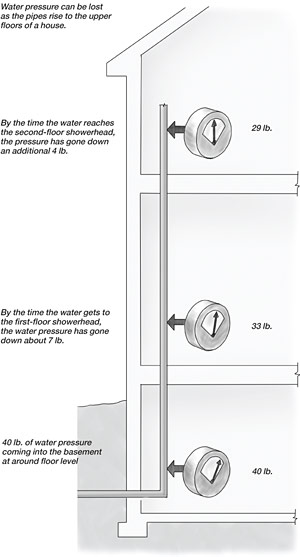
Ever wonder why you have less pressure in the upstairs shower than in the basement? It’s because it takes more pressure to get the water all the way up there. For every 2.31 ft. of vertical climb in your water line, you lose a pound of water pressure. Thus water that enters the house at the basement level loses 11 lb. to 12 lb. by the time it travels to a second-floor showerhead. If your house water pressure is already at the low end—40 lb. would be low and 80 lb. would be high—this is a significant loss.
Now let’s add in a water softener and an iron filter. These water-conditioning units each decrease water pressure by about 5 lb. of pressure; therefore, we lose another 10 lb. of pressure after water conditioning.
If the water pressure entering the house is sufficient (50 lb. to 80 lb.), you could survive the pressure loss. But in rural areas where incoming water pressure might dip down to 30 lb., there will be a problem. If added to this there are other poor conditions, such as too small or clogged pipes, improper valves, or poor showerheads, the flow may be reduced to a trickle.
Pinpointing the problem
To determine whether or not the city water supply to the house is responsible for the low-pressure problem, cut a T into the main water line right after the main shutoff valve. Into the center of the T, install a water-pressure gauge. The gauge will give you a reading of any pressure drop in the system right where the water comes into the house. For example, if the gauge shows a dip in water pressure for a few minutes after you flush the toilet, then you’ll know the problem is with the water coming to the house. If the gauge shows no such drop, then the problem must be with the house lines. They may be too small in diameter or fittings, such as globe valves and stop and waste valves, may need to be replaced with full-flow ball valves. Or if you have galvanized pipe, there is a good chance that rust deposits inside the pipes are decreasing the inside diameter of the pipe and restricting the water flow.
Local problems
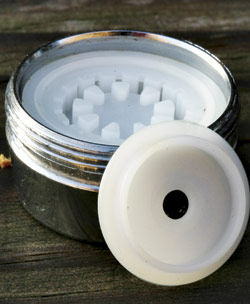
Sometimes a pressure problem can be solved locally. For example, low pressure at one faucet is often the result of a clogged screen at the tip of the spout. Clean it or replace the aerator. In the shower, the most common problem is a water-saver showerhead. This device conserves water by forcing the flow inside the showerhead through a tiny hole; the restriction kills all the pressure. Though this device has its place in the city, it can make a rural low-pressure problem intolerable. A restricter can be unscrewed from the head or drilled out.
Another common showerhead problem is an obstruction, such as sand and iron particles that get stuck in the head itself, that reduces the flow to a trickle. If you have hard water, which contains lots of minerals, you will have occasional problems with mineral buildup around the holes in the showerhead. Soak the showerhead in vinegar for a couple of hours to dissolve the minerals. Or simply replace the showerhead; some good-quality models sell for less than $10. The best ones sell for around $35 and up.
Whole-house problems
If the low-pressure problem affects all the fixtures in the house, then it is not a local point-of-use problem. It is either low pressure at the point where water enters the house or something is restricting the water in the main line. If the pipe feeding the house or serving as the main line within the house is old galvanized pipe, then the problem is likely an accumulation of iron deposits within the pipes themselves. The deposits can be so thick that the water is just barely getting through. The solution is to replace the pipe. If the pressure problem affects a group of fixtures in one area, the culprit is probably the branch feeder that supplies those fixtures. To solve this problem, you will have to find the one affected pipe and replace it—and perhaps all the pipes it feeds. If the corroded pipes are within a wall, the most common solution is to cut the pipes off flush with the wall and plumb in a new pipe through the floor to the fixture.
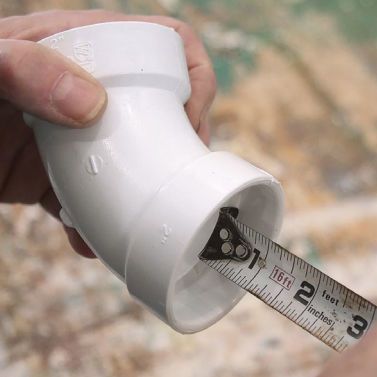
If the pipe that enters the house is 3/4 in. or larger in diameter and if it is made from polyvinyl chloride (PVC), copper, or polyethylene, then it is unlikely the entry pipe is the culprit because these pipes do not fill up with iron deposits. However, I have seen instances of low water pressure/volume caused by polyethylene splitting, PVC cracking, and copper corroding through. The most common place for polyethylene to split is within 3 ft. of the house where dirt tends to settle, pulling the pipe down with it. Buried fittings, such as an underground coupling or elbow, are also high on the leak list for any pipe.
Tip: The best place to check for unobstructed water pressure is at the tub. There are no restricters or screens in the tub spout.
Rural problems
Rural areas tend to have more water-pressure problems than urban centers. For one thing, rural systems often rely on pumps, whereas city folk have utility companies. If your house has a jet pump, then you may have to live with the problem. You’ll know you have a jet pump if you can see and hear the pump. The other type of pump, a submersible pump, is installed down in the well; you can neither see nor hear it. The only way to improve the water pressure in a house on a pump system is to adjust the pressure switch.
Houses at the end of the city water line
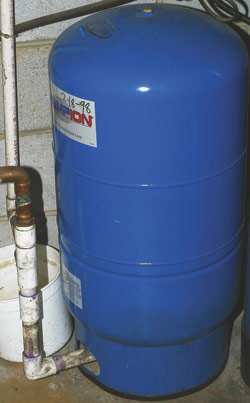
Rural-style water-pressure tanks can be installed on city water systems to add extra water for short duration high-demand periods.
Adjusting a pressure switch
Rural water systems use a pump to push water into a water-pressure tank (pressurized with air). The pump turns on at a low pressure of around 30 lb. and off at around 50 lb. Thus the pressure you feel in the house and at the shower will fluctuate. The pressure is adjustable at the pressure switch, which is located adjacent to the pressure tank. To raise the system pressure, first turn off the power to the pump and remove the cap on top of the pressure switch. Here you will see two threaded posts, one tall and one short, with a nut around each. Do not touch the short post. To increase water pressure, give the plastic nut on the tall post a clockwise turn. Each complete turn will increase water pressure by about 2 lb. When done, put the cap back on the pressure switch.
If you raise the pressure of the water, you must also raise the air pressure in the tank if you have a bladder tank. The rule of thumb here is that you need 2 lb. less than your cut-in pressure (the pressure indicated on the tank’s pressure gauge when the pump turns on). Thus if you raise the cut-in pressure of the pressure switch to 40 lb., you want 38 lb. of air in the tank. You must check the air in a bladder tank only after the power to the pump has been removed and the system has bled down to 0 lb. of water pressure (the air is trapped above the bladder and does not bleed out with the water). If you have an old-style galvanized tank, you don’t have to do this. You will notice, however, that the tank will attempt to waterlog faster, and you will have to shoot in air on a more regular basis to compensate.
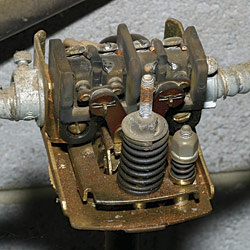
Once done, turn the power back on. If the tank takes more than 5 minutes to fill, return the system to the way you found it. Either the well can’t give you enough water or the pump is worn out and can’t get the pressure up.
You can increase the size of the water storage tank, but that will not necessarily raise the pressure. It will give you more storage water, which will minimize pressure fluctuations and will be helpful if the power goes out.
Booster pump
To actively increase the water pressure, you will have to install a booster pump. Installing a booster pump on a city water system, or even a rural water system that uses gravity-fed water, is quite easy. All you do is take the main water line as it enters the house (after the main turnoff valve) and feed it into a jet pump or booster pump. The output of the pump goes to a water-pressure tank, and the output of the tank then goes to the house water pipes. The disadvantage of such a system, if you are used to the constant pressure of city water, is that you now have fluctuating water pressure. But the lowest pressure will still be higher than what you had before, and the upper end may be 20 lb. higher. Typically, a booster system can increase your pressure by 50 lb. to 70 lb., if needed. Expect to pay around $800 or more, plus labor.
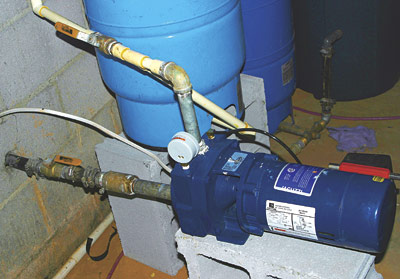
Installing a booster pump
Low water pressure is a common complaint, especially for bathrooms on upper floors. If you live in the city, you may have low pressure coming into the house. If you live in the country, you may have an old pump that can’t raise enough pressure or the pump may need to run 20 minutes to get just a couple pounds more. If your pump is not old, you may be able to have a plumber adjust the pressure switch (and then the air in the bladder pressure tank). Whether in the city or the country, many people think they have to live with the problem. Not true. All you have to do is install a booster pump in your basement or crawlspace.
For city dwellers, the pump needs to be installed in the main water line just past the main shutoff valve. Country folk install the booster pump where the water comes into the house just before it goes into the pressure tank.
Though most any jet pump will work, I install only the Jacuzzi RP2. It is designed so that the low-pressure water feed goes right into its nose, and you then have several options for places (3/4-in. female threads) to take off the high-pressure water. The motor is universal—that is, either 120 volts or 240 volts—and can be replaced without disconnecting any of the plumbing.
In the real-life situation described here, my customer wanted to increase his house water pressure. His water came from another house about 200 ft. away, and by the time it got to his house, he had only 20 lb. to 30 lb. of pressure. We wanted to increase pressure in his house without adversely affecting pressure in the other home, just as a city dweller would want to increase the pressure in his or her house without increasing pressure in the city water lines.
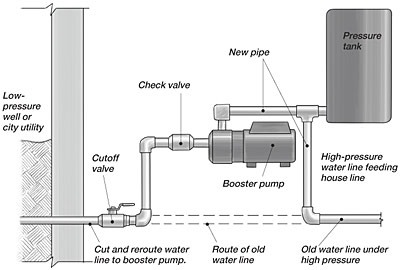
The solution is a booster pump with a check (one-way) valve. The pump takes the low-pressure water coming into the house as its input and builds the water pressure. At the same time, the one-way check valve keeps the pressure from bleeding back through the pump and into the lines. Without the check valve, you would be attempting to pressurize the city water system once the pump turned off. To install the check valve, screw a 1-in. nipple into the pump head. Screw on the check valve. (Be careful not to install the check valve backward; it should open toward the pump head.) Some pump manufacturers have built in the check valve; if so, do not add a second. The incoming water line connects into the check valve.
The problem with water-conditioning systems
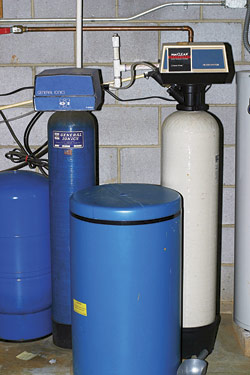
Water-conditioning systems are a major contributor to water-pressure loss. Of course, manufacturers rarely advertise this juicy bit of information. As I noted earlier, you’ll lose a minimum of 5 lb. of pressure as water flows through all the unit’s pipes and tanks. With a multiconditioning system you can lose up to 10 lb. When I install a conditioning system in the country (pump system), I always try to raise the pressure at the house’s point of entry by 10 lb. If your house is supplied by city water, you will have to either live with the problem or install a booster pump.
The valve factor
I once did a service call for which the complaint was low water pressure. The system was brand new—the customer had put it in himself. Wanting to be able to isolate every line in the house, he must have had 20 valves cut in. His logic was good; it’s nice to be able to isolate a water problem using valves. But the wrong type of valve means lower pressure and less water volume. He used globe and stop/waste valves, which slow or restrict water pressure. I replaced every valve in his system with a ball valve, and the problem was solved.
Tip: To keep water pressure at its maximum, install only ball valves throughout the water system.
Rex Cauldwell is a master plumber and electrician. He has written several books published by The Taunton Press, including Wiring a House, For Pros By Pros: Plumbing, and Inspecting a House. Photos by: Rex Cauldwell; drawings by: Chuck Lockhart



View Comments
Thanks for the very informative article, but I have a problem that wasn't mentioned... We have all new plumbing in a small, one story house with a new submersible pump and a bladder tank that stays at 40-60 lbs pressure. The water pressure is great until we install a few filters (sediment, iron, and carbon) for the UV filter to work properly. These are the 5x20" whole house canister types that should provide more than 20-30 gallons of water before they slow the pressure down to a trickle to 0 water. The guy that sold me the unit said I needed to install a booster pump after the filter array to suck the water through the filters even though my water tank has adequate water pressure. My iron level is low (0.3mg/L) and I have 2 Rusco spin-down sediment filters before the large canister filters. Can the filters clog so fast that the water pressure goes down to zero so quickly? Thanks