previous
  • Patrick's Barn: A Perfect Place for a Party
    Patrick's Barn: A Perfect Place for a Party
  • How To Make a Reciprocating-Saw Blade Guide Block
    How To Make a Reciprocating-Saw Blade Guide Block
  • How to Avoid Complicated Fractions
    How to Avoid Complicated Fractions
  • Fine Homebuilding: The Current Issue
    Fine Homebuilding: The Current Issue
  • The Self-Taught MBA: Inspired Reading
    The Self-Taught MBA: Inspired Reading
  • Fine Homebuilding: The Digital Issues
    Fine Homebuilding: The Digital Issues
  • 7 Small Bathroom Layouts
    7 Small Bathroom Layouts
  • Your Guide to Energy Smart Homes
    Your Guide to Energy Smart Homes
  • Replacing a Roof : Installing a Ridge Vent
    Replacing a Roof : Installing a Ridge Vent
  • The Inspector Game: Goofs on a Roof
    The Inspector Game: Goofs on a Roof
  • Top 10 Videos of 2011
    Top 10 Videos of 2011
  • VIDEO: Stop Paint from Bleeding
    VIDEO: Stop Paint from Bleeding
  • Wanted: Plumber for a Bathroom Remodel
    Wanted: Plumber for a Bathroom Remodel
  • Seven Steps to Choosing the Perfect Circular Saw
    Seven Steps to Choosing the Perfect Circular Saw
  • 10 Basement-Remodeling Tips and Techniques
    10 Basement-Remodeling Tips and Techniques
next

The Right Way to Set Up and Climb a Ladder

Simple guidelines minimize the risk of serious injury

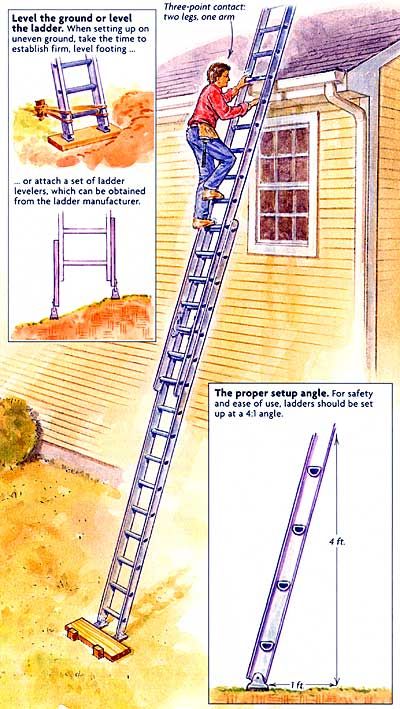
Because ladders are the most mobile and temporary devices for working above the ground, it's easy to be lax about their safe use. Serious, debilitating injuries often result from falls of 6 ft. or less. Take the time to set up a ladder properly, as explained in the list and shown in the drawing.

  • Ladders should be set up at a 4:1 angle (1 ft. out from the base for every 4 ft. of rise).
  • To prevent them from slipping or falling over, ladders should be secured either at the top or at the bottom.
  • When ladders are used to climb onto or off of an upper surface, they must extend at least 3 ft. above the surface.
  • When climbing or working on a ladder, the worker should face the ladder and maintain three points of contact with the ladder.
  • Do not set up ladders in high-traffic areas
More Info

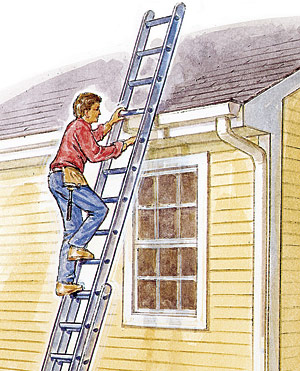
The base of this ladder is securely braced to prevent slipping. The worker maintains three points of contact while climbing the ladder and has plenty of extension above the roof surface to enable him to get on and off the roof easily .
Tom O'Brien is associate editor at Fine Homebuilding.

Drawing: Rick Daskam

From Fine Homebuilding130 , pp. 89 April 1, 2000