
Pulling stubborn nails
Sometimes, a hammer claw is ideal; other situations might require a cat's paw or a pair of nippers.
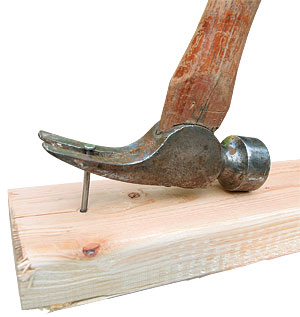
My second job in construction—after I got through scraping a big stack of foundation formboards—was to remove the nails from a pile of salvaged 2x4s. It didn’t take long for me to discover how easy it is to break a wooden-handled hammer while pulling nails. At the time, I didn’t own two hammers, but my boss did. Before he would let me borrow one of his hammers, he taught me a few tricks.
In its nail-pulling function, a hammer works like a lever. I learned that reducing the distance from the nail head to the fulcrum, or pivot point, reduces stress on the hammer. You can do this in a couple of ways just by changing the hammer’s position. Also, a couple of common tools, such as a cat’s paw and a pair of end-cutting nippers, make nail-pulling easier.
For pulling finish or siding nails, I like to have a flat bar handy. I can put it under the hammer or nippers and avoid denting the wood.
If you spend any time pulling nails, you’ll quickly realize that the rough-textured surface on galvanized nails makes them much harder to pull out. They’re also more likely to bend or break. For these reasons, I use galvanized nails only when I am absolutely sure I won’t have to remove them.
A hammer has more than one lever point
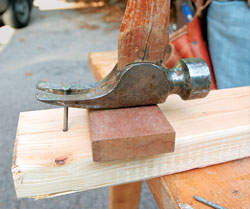
Pulling straight back is the hardest way. With a straight-clawed framing hammer, the fulcrum quickly moves to the front of the hammer, the point farthest from the nail. This is the least-preferred method for removing tough nails. It requires the most effort and puts the most stress on the hammer handle. Placing a block under the head of the hammer will help. It reduces the fulcrum’s distance to the nail and makes it easier to pull out the nail.
Levering to the side is easier. Using the side of the hammer’s claw as the fulcrum provides the most leverage. Unfortunately, the nail will be removed a correspondingly short distance.
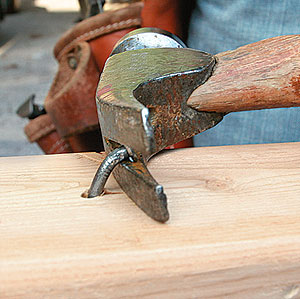
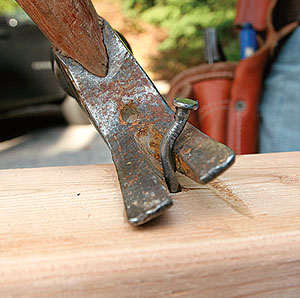
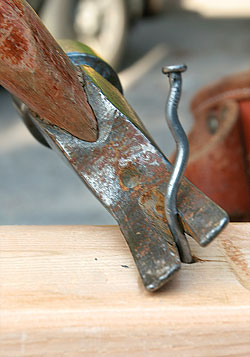
Reengage the nail. By reengaging the nail and levering the hammer back and forth, you can pull out the nail in increments.
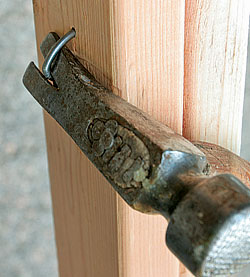
One turn will work. Instead of rocking back and forth, the hammer can be levered in one direction. If the hammer handle can pass by the edge of the wood, as shown at left, the nail can be twisted out with one motion.
Lighter puller
A hammer and a cat’s paw make up a significant chunk of my tool bag’s heft. Luckily, Stiletto Tools (www.stiletto.com) has found a way for me to shed some weight without shedding tools.
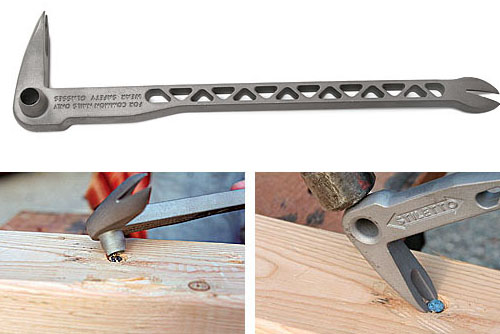
Besides their famously light hammers, Stiletto has introduced a claw bar (model TICLW12) that tips the scale at just over 8 oz., about half the weight of the one I usually carry. This lighter titanium tool is pound for pound much stronger than steel. It has an engineered webbed handle and sharp pry tongs.
The cool feature on this claw bar is its Dimpler, located on the side of the head. When positioned over a nail head and struck with a hammer, it crushes the wood fibers and allows the pry tongs to grab the nail easily.
The Dimpler lets me remove an embedded nail without digging into the wood. The only drawback is that at $89, the lighter weight and convenience of this claw bar don’t come cheap.
Other tools make pulling nails easier
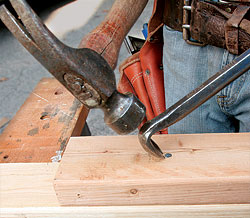
A cat’s paw grabs an embedded nail. The hook of a cat’s paw is designed to be driven under the head of a nail flush with the surface.
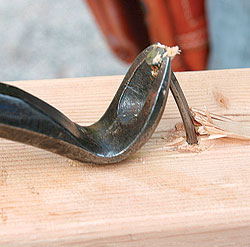
The force is in the curve. The tight curve on a cat’s paw provides plenty of pulling force as you push the handle.
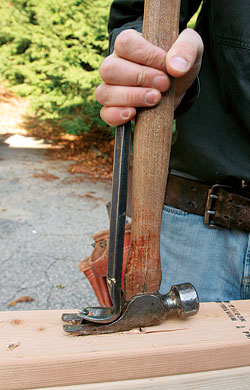
A hammer provides more travel. One pull with a cat’s paw typically won’t free a nail. By slipping a hammer under the cat’s paw, the travel will be enough to clear the nail.
Nippers take care of the finish
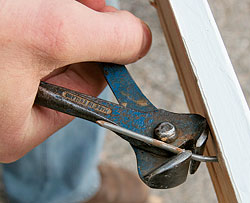
Pulling nails through the back saves the surface. The smaller head of a finish nail allows it to be pulled through the back of a board with a pair of end-cutting nippers. This prevents the “show” side of the molding from being damaged.
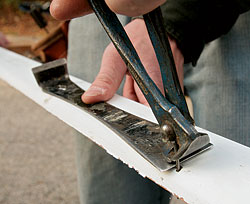
A flat bar protects the trim. If the nail has to be removed from the front, put a flat bar under the nippers or hammer. The pressure from the nippers then is spread over a larger area, minimizing the chances of denting the wood.
Photos by: John Ross, except where noted

View Comments
Pulling finish nails or pulling through the back (works great to preserve older molding faces) is not all that hard once you clamp locking pliers (Vice Grip is a common brand) on the nail.
Slip the pry bar around the nail.
Clamp the locking pliers on the portion of the nail sticking above the pry bar.
They meed to be clamped as tight as you can get them.
Now pry against the jaws of the locking pliers.
It is a little slower than pulling common nails, but once you get the pliers set tight enough is pretty fast.
For longer nails you can simply unlock the pliers, slide mire of the nail into the jaws, lock them again, and pry another section out.
It works on common nails that have corroded heads that strip off also.